Saturday, January 26, 2013

Shore Acres proves wet and wild!

A little over a year ago, I joined the Emerald Photographic Society here in Springfield, Oregon.  I've been a photographer for years but I've always wanted to go on photoshoots with other photographers - not only to learn new techniques I may not have tried but to share the companionship of others who enjoy photography as much as I do.

Sandstone shelves at Shore Acres Estate near
Coos Bay, OR.  Photographed by Mary Harrsch
I've enjoyed myself since then traveling to the Evergreen Air and Space Museum in McMinnville, to blooming pear orchards near Hood River, Oregon, to a bird sanctuary named Cabin Lake (there's no water though!) near Fort Rock in the eastern Oregon desert, to Wildlife Safarai near Roseburg, Oregon where I photographed everything from its signature cheetahs to a white rhino that fell madly in love with my friends gray car!

This past weekend,  I and three other photographers from the photography society went down to Shore Acres to practice long exposure photography (so the water running off the rocks would look "silky").

Shore Acres was originally the estate of pioneer lumberman and shipbuilder, Louis J. Simpson and his wife Cassandra, constructed in 1906-1907.  The mansion Simpson built there was surrounded by five acres of formal gardens populated with trees, shrubs, and flowering plants (predominantly roses and various species of rhododendrons) brought to his retreat aboard his fleet of sailing ships.

Shore Acres original house constructed by
lumber magnet Louis J. Simpson.  Image
courtesy of Oregon State Parks Commission.
Simpson eventually developed the summer home into a showplace three-story mansion complete with a heated, indoor swimming pool and a large ballroom. In the center of his botanical plantings he constructed a Japanese-style garden built around a 100-foot lily pond.

But tragedy struck the Simpsons in 1921 when first Cassandra died in April then fire destroyed the mansion in July. Not to be defeated, Simpson began to build an even larger replacement - two stories high and 224 feet long.  He also remarried, bringing his new wife Lela Gardner to Shore Acres in 1922.  The couple adopted two infant girls and lived in the gardener's cottage until the mansion was completed in 1928.   But Simpson, like many other businessmen suffered huge financial losses in the 1930s and, bankrupt, lost the heavily mortgaged Shores Acres.  The mansion and grounds languished unattended and fell into disrepair. In 1942, Simpson's beloved Shore Acres, once a showplace but now only a deteriorating relic, was purchased by the state of Oregon for use as a public park.  The mansion was razed and once more only the gardener's cottage remained.  The state did, however, restore the gardens and built an observation structure on the site where the mansion once stood.

I have visited Shore Acres a number of times when I lived in Bandon, about 26 miles south of the park.  I picnicked there with my grandparents and have attended the annual holiday lights festivities, warming myself in the gardener's cottage with a cup of hot cider and delicious cookies.  I was always fascinated by the fact that horseshoe imprints could be seen on the very edge of the bluff where decades earlier visitors to the Simpsons home had traveled there on horseback.  Now the bluff is so eroded by the wind and waves, only the edge of the once circular driveway in front of the mansion remains.  

I had always gone to the main bluff where the tourists go to the observation shelter. But this time one of my companions suggested going down the trail to the right of the parking lot down to the sandstone outcroppings next to the remains of the Simpson's tennis courts.

The sandstone formations are wonderfully bizarre - sort of like small yardangs that form in the Sahara.  The only problem we had was towards the end of our time there, I was working near the ledge about two levels up from where the waves were crashing and all of a sudden three humongous waves formed really close to the bluffs and literally exploded against the rocks sending a huge shower of water down onto me and another friend.

I was just around the corner from the trail observation area seen adjacent
to the trees on the bluff in this image.  Image Courtesy of the Oregon State
Parks Commission.
Fortunately, the force of the waves was expended so we just got terribly drenched and not swept off the rocks.  I had seen the size of the wave forming through my viewfinder and fortunately had just stepped back from the ledge and was walking back to the next level when I turned and realized I was going to be hit.  I clasped my camera to my chest and grabbed the strap on my camera bag that one of my other friends had scooped up along with my tripod and braced for impact.  We both got soaked to the skin and our cameras got really wet which worried me since they are all electronic.  But my LCD screen never blinked even once.

We got back to the car and wiped our cameras down as best we could then headed back to Springfield.  The heater in the car dried us out to some extent but the evening air was chilly and when we stopped for dinner at the Firehouse Restaurant near the waterfront in Florence I was shivering (great sea scallops topped with bay shrimp in garlic sauce there by the way!)  When I got home I had to take a hot bath to warm up my core!

I should have been more mindful of the taciturn nature of the ocean since I was raised down there, but those sneaker waves can be treacherous!  Kurt Pratt, one of my photographer friends, was teasing me that he should have gotten a long exposure shot of all of the water running off of my backside!

Enhanced by Zemanta

Wednesday, July 28, 2010

Swiss Family Robinson would love the Treehouse "Treesort"

A friend sent me information about a relatively new resort about 10 miles from Cave Junction, Oregon that looked really intriguing!  The Treehouse "Treesort" offers an assortment of furnished treehouses to rent to give any aspiring "Swiss Family" the opportunity to see what the forests of southwest Oregon look like from a bird's point of view!


The Cavaltree Fort can sleep up to 7 people and shares a
swinging bridge with the "Treeloon", a treehouse fashioned
after a wild west saloon.  Image courtesty of the Treehouse
Treesort.


The treehouses range from a more posh Schoolhouse Suite  featuring a master suite with queen size bed, kitchenette and full bath with claw-foot tub and shower to the Cavaltree Fort, a two story treehouse that sleeps up to seven people. The first floor of the fort has a double bed under the tented portion with an adjacent observation deck . The second floor is built like a lookout tower with a bunk bed and movable single bed that can be rearranged to form a double bed. It also includes a loft that can easily accommodate two more kids.  It is accessed by way of a swinging bridge.

I see the resort also offers a variety of outdoor activities including horseback riding, whitewater rafting, swimming in a river-fed rock lined pool and tree climbing with rappelling.  They even offer the chance to swing on a giant 750 ft high Tarzan Swing!  

One of the most popular activities is navigating over a mile of Zip Lines strung through the trees over the 36 acre property.  Zip lines are steel cables that guests can slide on using a special harness.  This video shows the variety of courses devised for both beginners and advanced zippers including the Achilles Line featuring a 500 foot plunge.


All in all it looks like a heck of a good time for families who enjoy the outdoors. Although pets are not allowed at this resort, the owners say they have friends that offer a very clean kennel close by.

Wednesday, July 22, 2009

United Breaks Guitars

A friend sent me a link to this video and I cracked up. I, too, have been a victim of United's outrageous so-called customer service. When I was fell in Naples, Italy in 2007 and tore both left and right rotator cuffs in my shoulders, I had to book a flight home to have the damage surgically repaired. I requested medical assistance when I booked the flight. The leg of the flight from Naples to Munich was AirItalia and I was treated with the utmost kindness. Then in Munich I transferred to a United plane for the flight across the Atlantic. When I asked for assistance with my carryon bag - and I was trussed up in a sling applied by the emergency room doctors in Naples - a snotty United stewardess told me I'd just have to try to find some other passenger to help me because she had a bad back and stalked off.

Sunday, December 21, 2008

Exploring Cabela's Animal Exhibits


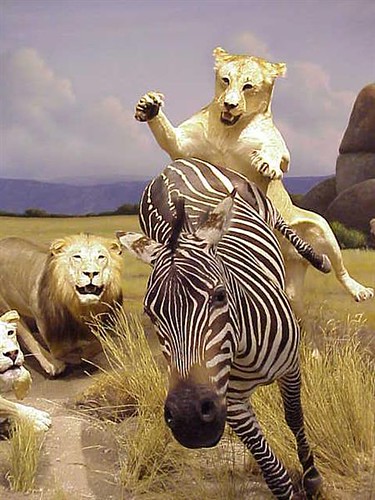
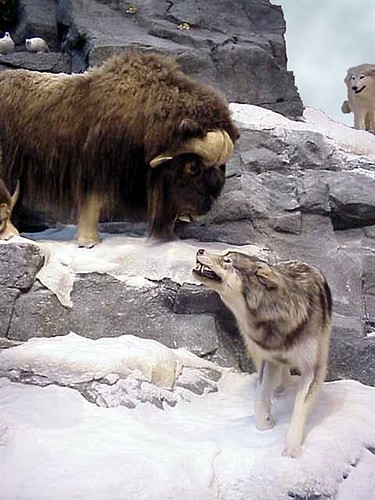
My sister-in-law took me to my first Cabela's while on a visit to Minnesota back in the 1990s. When she first suggested going to an outdoor store I didn't know what could be so interesting as I'm not into camping or hunting. I didn't even bother to take my camera. So when we got there and I saw the spectacular animal exhibits I was awestruck and insisted we return the next day so I could photograph them. I returned the next day and shot pictures until my camera battery died. Since then I have made a point of visiting every Cabela's we have encountered in our travels. So far, we have visited Cabela's in Owatonna, Minnesota, Mitchell, South Dakota, Sidney, Nebraska, and Hamburg, Pennsylvania. I missed seeing the exhibits in the Lehi, Utah store by only one week (the store was brand new and wasn't going to be open for another week). And I could not find reasonably priced ground transportation to see the Cabela's on the outskirts of Fort Worth, Texas when I was there for an Educause conference a couple of years ago. Now I understand there are stores in Washington state and outside Boise, Idaho. I hope to visit them next summer.

Cabela's does such an outstanding job of posing the animals in lifelike settings and engaged in lifelike movements that I found their exhibit far superior to the newly refurbished "Hall of Mammals" at the Smithsonian Museum of Natural History that I visited in 2004. Cabela's gave me an opportunity to become a virtual wildlife photographer without the travel and physical endurance required by expeditions to rugged and remote environments. The central mountain is illuminated by an overhead skylight so there is enough natural light to shoot many of the exhibits without flash, enabling you to capture the natural colors of the fur or feathers.

A fellow photographer up on Flickr disdainfully commented "but they're all dead!". Yes, that is true, but by preserving their natural beauty, Cabela's provides an opportunity to study the detail of each species and creates a learning environment unmatched by many museums. In fact, many surrounding schools take their students to Cabela's on field trips.

Cabela's also gives aspiring photographers an opportunity to compose images more artfully, and zoom in for the kind of closeup only a highly skilled "National Geographic-type" photographer can produce in the wild.

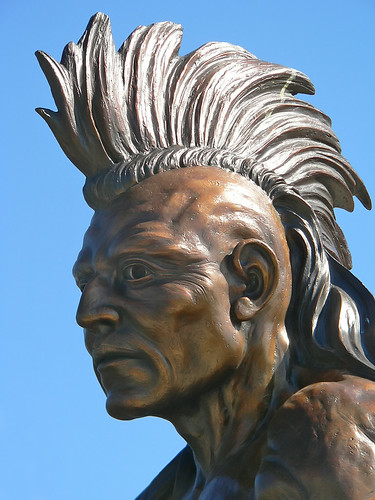
Each Cabela's store also displays a unique bronze sculpture in front of their store for art lovers like me to admire. This Native America warrior is paddling a canoe in front of the Cabela's store in Hamburg, Pennsylvania.

Cabela's usually place their stores in rural settings along interstate freeways so they are easy to access by car and are frequently advertised several miles in advance for the happenstance encounter. Cabela's provides ample parking and kennel service if you are traveling with a pet and the weather is either too hot or too cold to leave them in the car during your visit. They also house a restaurant so you can take all the time you want and not worry about what to do for breakfast, lunch, or supper.

I designed a website to display some of the beautiful exhibits I photographed on some of my first visits. Later, I uploaded my images to a Flickr photoset since I have taken literally hundreds of pictures and wanted to make them available to students and teachers for learning projects and exercises. All of my images are licensed with Creative Commons Attribution Share-Alike 2.0 permissions which grant the right to use them freely for noncommercial purposes as long as you include the credit "Photo by Mary Harrsch" and any derivatives are shared in a like manner.

Sunday, October 05, 2008

Sharks in Venice


No, I really didn't see sharks in Venice. In fact, I've never been closer to Venice than the Grand Canals in The Venetian Hotel in Las Vegas, but I hope to see it in one of my future Italian sojourns. However, I saw this video clip about a direct to DVD film coming out in January 2009 entitled "Sharks in Venice". It appears to be a Stephen Baldwin effort at imitating Indiana Jones. But, when I saw a huge shark chomping the center of a gondola I burst out laughing. I always thought the gondoliers' singing was never that bad!! Anyway, I had to share it with you.

Saturday, October 27, 2007

A Journey Gone Wrong - Naples, Italy October 2007

October 9 &10, 2007

Well, I've finally arrived in Naples after a journey from hell. Everything went fine until I reached Munich and the fog was so thick you couldn't see the tip of the aircraft's wing. All the direct flights to Naples were cancelled but by afternoon, Lufthansa booked me on a flight to Milan along with a group of 16 other American women that were flying to Naples to meet a tour group. However, the Milan-bound flight took so long to leave Munich that we missed our connecting flight to Naples.

Lufthansa rebooked us on a later flight to Naples but when it got ready to board, they discovered a mechanical problem so we were told we would have to wait another two hours for another plane to fly in from Istanbul. It finally arrived and ferried us on down to Naples but we arrived with no luggage. Miraculously, AlItalia managed to track it down and return it to me about a month after I came home. The zipper was broken but even my $1500 CPAP machine (I have severe sleep apnea) was intact.

So I had only the dress I was wearing and one change of underwear (I rinsed a pair out every night so it could dry during the day and give me a change for the next day), my computer, camera gear and medication but nothing else.

To top things off, I severely wrenched my right shoulder trying to pack my carryon bag up a 60s style gangway in Munich because the airport doesn't have moveable jetways or at least not for smaller aircraft than those used for long distance trips. They load passengers on a bus that takes you out to the aircraft parked on the tarmac and you must pack your carryon up a stairway.

Anyway, the bus was packed with passengers and when the bus door opened to enable us to disembark the crowd surged forward with someone stepping in front of my carryon and the rest of the crowd pushed me forward causing me to lurch forward while my arm gripping the carryon was pulled backwards. The net result is that now I can't lift my right arm above about waist high without assistance from my left hand which makes taking pictures a rather painful challenge. Still, I was determined to carry on.

I suspected I'd torn the right rotator cuff but if I went to the doctor they would probably put it in a sling and I couldn't take pictures at all then so I stopped at a pharmacy and got a tube of ibuprofen gel to rub into it. I soaked my shoulder in a hot shower then rubbed on the gel and I really do think it helped. Quite honestly I had never heard of this gel version of ibuprophen and I guess I'm not alone because when I mentioned it to my doctor after I got home she didn't seem to have heard of it either.

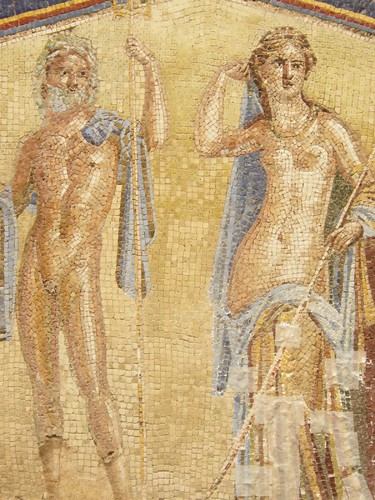
In spite of all this, I managed to photograph all of Herculaneum although I probably took less pictures than I normally would. The beautiful mosaic at right was discovered in the House of Neptune and Amphitrite in the bath complex and is being carefully conserved.

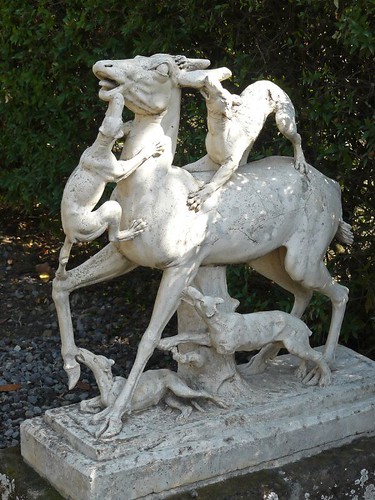
Reproductions of some of the sculpture of the period discovered at the House of the Deer are now displayed on the site (as seen right).

Ancient tradition connected Herculaneum with the name of the Greek hero Herakles (Hercules in Latin and consequently Roman Mythology), an indication that the city was of Greek origin. In actuality, it seems that some primitive forefathers of the Samnite tribes of the Italian mainland founded the first civilization on the site of Herculaneum at the end of the 6th century BC. Soon after, the town came under Greek control and was used as a trading post because of its proximity to the Gulf of Naples. It is the Greeks who named the city Herculaneum. In the 4th century BC Herculaneum again came under the domination of the Samnites. The city remained under Samnite control until it became a Roman municipium in 89 BC, when, having participated in the Social War ("war of the allies" against Rome), it was defeated by Titus Didius, a legate of Sulla." - Wikipedia

More of the multi-story architecture has survived in Herculaneum than in Pompeii although most of the art has been removed and sent to the archaeological museum in Naples. There was still some incredibly bright mosaics in a bath complex though. A few frescoes remain in situ as well although they are pretty faded. There is a lot of conservation work going on though which I was glad to note. I also noticed that some of the columns were painted red just like those portrayed in HBO's "Rome".

It started to rain in the afternoon so my English photographer colleague and I popped into a restaurant. The little "ristorante" was decorated with dozens of colorful ceramic plates that reminded me of the beautiful collection of Maiolica ceramics I had seen at the Legion of Honor Museum in San Francisco last year. I seriously doubt they were made in the 16th century though!

The shopkeeper showed us a little closet that was actually a tiny lift to take us up to the garden level. The tables were arrayed under an overhead trellis covered with vines of some type. I had a nice lunch of ciabatta bread, green salad with tomatoes and Mozzarella cheese, and tortellini in a delicate cream sauce. My colleague Richard ordered a bottle of wine but said afterwards that he doubted if it had ever seen a grape. I asked him what he meant by that and he said that you can produce wine chemically without grape juice and that was probably what had been served. I had never heard of such a thing and since I don't care for the taste of anything with alcohol in it I guess I won't ever care about it.

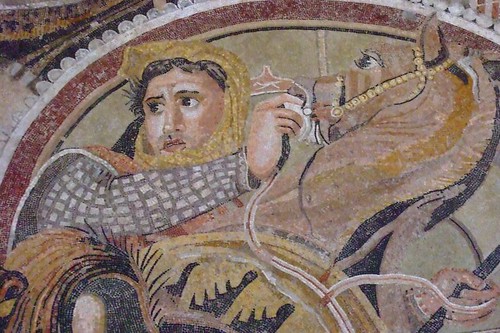
With still quite a bit of the afternoon to see, we caught the train back downtown to go to the Archaeological Museum. I finally got to see the famous Alexander defeating Darius at the Battle of Issus mosaic which was on my must see list. I had always thought it portrayed the final battle at Gaugamela but all the references say Issus so I guess I have to go with that. I wonder if there was an inscription saying Issus and not Gaugamela? I've also always wondered about the portrayal of Alexander with an out-of-proportion eye compared to the more realistic Persian warriors. I know the "Evil Eye" was much feared in the ancient world so I wonder if this distortion means the conquering Alexander possesses the ultimate source of knowledge and yes, even evil, and is thus unconquerable.

I couldn't get very good pictures of it on my first visit because the museum was full of tour groups and, like the tour groups that visit the Louvre all seeking a peek at the famed Mona Lisa - they clustered in front of it. I had better luck later when I returned on my last day before departure. Mondays apparently are less busy.

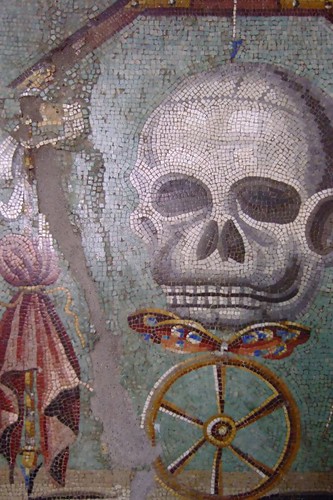
Of course the museum contained many other spectacular mosaics well worth a visit as well. I was surprised to find the mosaic of the Skull image used as the graphic for the intro to HBO's "Rome" miniseries. "Memento Mori" caught my eye immediately as I entered that portion of the gallery. I half expected the little wings beneath the skull to flutter and the skull itself to rock back and forth and Rome's theme music to begin playing since I have seen that graphic so many times as a fan of the series!

Other mosaics of note included one of the Dioynisian Mysteries, a famous one of animals from the Nile Valley, some with fishes, and one of a cat that looked identical to one I saw on my last trip to Rome in the National Museum.

I managed to get into the "must be over 18 to view' room of erotic art from the brothels and was surprised how mild the images were. Of course the Victorians were pretty prudish. I must admit though, that a couple of Priapine lamps were a bit over the top. I'll have to flag my picture of them "might offend" on Flickr!

Of course I was thrilled to see two famous statues of my "hero" Julius Caesar as well as an impressive colossal bust of Vespasian and an interesting bust of a very young Commodus that did not resemble his father Marcus Aurelius nearly as much as a bust of him as an older man wearing his Hercules lion garb that I saw at the Capitoline Museum in Rome

There was also a dynamic sculpture of worshippers wrestling with a sacrificial bull that once graced the halls of the Baths of Caracalla in Rome. Apparently it was purchased by a very wealthy Neopolitan family (The Farnesi) so it ended up down here instead of Rome.


Day 3

Well, things just don't seem to be working out on this trip. The ibuprofen gel had helped enough with my shoulder that I could take pictures as long as I lifted my one arm with the other one and helped support it but tonight when we were hurrying to catch a bus I didn't see a hole in the pavement and went down really hard wrenching both shoulders pretty severely. I couldn't even pour my own glass of water at dinner or even put the strap of my camera bag over my shoulder. Even typing this note is extremely painful and I've had a shower and doctored both shoulders with the painkilling gel.

To make matters worse, while I was still trembling from the fall, a man in his fifties came up the aisle of the bus and acted like he was just trying to hold on but started pressing his pelvis against my leg (I was sitting on an aisle seat and the bus was crowded and I had nowhere else to go). At first I thought he might just be lurching a little from the bus but the more I tried to scoot away from him the more he pressed against me then his movements became "rhythmical". It was like being raped in public. I didn't know what to do because if I made an issue of it he could just innocently claim he was just trying to hold on. I was also too embarrassed to tell Richard who was watching out the window for street signs so we would get off at the right stop. Thankfully, the man finally moved on. When we got off the bus, I asked Richard if he would let me sit next to the window in the future and I broke down and told him what happened. He was furious someone would try to do that to me so maybe its just as well I didn't say anything at the time. If he had struck the man he probably would have ended up in jail and I don't think his wife would have appreciated that. I know we joked about the old Italian custom of pinching before I left but this type of thing was totally disgusting. I guess I'm not as tough as I try to appear.

Tomorrow we are going to take the lift up to the top of Vesuvius and then spend the afternoon back at the Archaelogical Museum. I think I can do it if I get help on and off the train and Richard carries my camera bag. I don't know if I can manage any pictures but I don't want to spoil it for Richard so I'll just grit my teeth and try not to let it show. I think, though, unless I can get the pain back to a manageable level so I feel I can take care of myself without help, I'm going to cancel my train ticket and my reservation at the hotel in Rome and try to book a flight home.

I don't think I'll be able to work for a week or two except perhaps a little email from home. I'll have to see what the doctor says. I'm going to have to medicate pretty heavily just to try to drive the car back from Portland.

My luggage still hasn't shown up here. At least today I was able to find some underwear, a night gown, and another outfit to wear. I air out the dress i've been wearing overnight but it is surely getting a bit rank after all this time.

Day 4 & 5

The pain was so severe Saturday night that I had the desk call a cab to take me to the orthopedic hospital. I went up to Babelfish before I left for the hospital and wrote out a brief explanation of what happened, where it hurts, a short medical history, and my insurance and contact information and translated it all into Italian. The ER physician's assistant seemed to understand it so I guess the translation wasn't too bad. They X-rayed my shoulder and said there was no fracture but tied it up with a sling to keep me from pulling any more on the damaged muscle. It's kind of strange that the hospital does not prescribe any medications so I didn't get any pain medicine. I guess if I couldn't stand it any longer I could have gone to a pharmacy. Apparently a note online said pharmacists here actually prescribe medications. Richard had some arthritis strength pain tablets so I took those and rubbed on some more of the ibuprophen gel. Between the two things the pain finally was dulled enough to let me drift off to sleep for a few hours.

It was obvious that I was too injured to continue to Rome especially by myself so I cancelled my train ticket and my reservation at the hotel in Rome and booked a flight home. I was really upset as I was so looking forward to it. I guess my Trevi Fountain luck was not meant to be used this time.

I slept off and on Sunday. Richard went on up Vesuvius. He said it was just as well I didn't try it as the bus lets you off about 1 mile from the summit and it would have been quite a strenuous uphill walk. That evening we went out and got a bite at a restaurant and then stopped by a MacDonalds and picked me up a Caesar salad, some sliced apples, and a "Big and Tasty" hamburger. I told them to leave off the sauce so the bread wouldn't get soggy and stashed it in my little room bar refrigerator for tonight's dinner. The hotel is really quite beautiful but has no restaurant (except for hot rolls in the morning) and there are no restaurants nearby. Although the hotel is new it is in an old run down neighborhood and I don't trust going out alone - especially with my arm in a sling. It would be like advertising to the local predators.

Richard had to fly home today but before he left we took a cab back to the Museum. I only took the little Fuji since that's the only one I could use one-handed. I managed to photograph the rest of the museum in my effort to salvage something from this trip although it really aggravated the right shoulder - the one less damaged [As it turns out the one more damaged!]. I took a cab back to the hotel and downloaded my pictures to the Mac and then took a nap.

I made it home safely. All of my return flights actually ran on time and Terry met me at the security gate in Portland and drove me home. My main problem was getting assistance with my carryon bag. I guess the gauze sling looked hokey so nobody except the Italians took it seriously. I had requested special assistance all the way home but as soon as I left the Italians, I was pretty much ignored. The special assistance in Munich amounted to someone pointing at the elevator. When I boarded the plane I told the steward I would need help with my carryon bag and he said someone in the back would help me. I went to my seat with my carryon in the aisle and turned to look toward the stewards and stewardesses in the back and they just looked at me and kept munching their donuts. Finally I asked another passenger if he could get their attention for me and he came up and asked what I needed. I told him I couldn't lift my carryon and he snottily said "Well, who packed it?!!" I told him I had a torn shoulder and he roughly shoved it into the overhead bin and stalked back to his seat.

During the flight a stewardess came by asking if we wanted any additional beverage. The young man sitting next to me to her yes and I opened my eyes and said if she was bringing one for him I would appreciate one as well. She barked "PLEASE" and the young man and I looked at each other and humbly said "please". We certainly meant no disrespect, we were just answering her question although I must admit a "please" was probably appropriate but her aggressive correction was hardly necessary.

After the 8 hour flight I pressed the hostess call button to request help with the bag when we landed. Apparently the stewardess just turned off the call light. I waited another half hour then pressed the call button again and right away I heard them turn it off again. Finally, when the stewardess went by collecting cups I stopped her and asked her if someone could assist me with my carryon bag when we landed. She snapped "Well I've got a bad back! You'll just have to find another passenger to help you or something!" So much for United's "friendly skies!" Fortunately, the young man I was sitting with helped me with it without any snotty remarks.

Dulles airport in D.C. was a nightmare. It took almost two hours to get through customs and most of the delay was totally unnessary. They had you queue up for document checking which included looking at our customs declaration card. They they had you queue up again to pass by a guy who collected the customs declaration card (without looking at them or asking any questions) - ridiculous! Then they made everyone with luggage claim their luggage (of course it had already been inspected in Europe) and, without examining any of the contents (that I could see), queued you up to recheck your luggage! Then, of course, you had to pass through another security screening for your own person and your carryon bag even though you had just gotten off a plane that you had been screened to board in Europe. It finally occurred to me that the entire charade was not about Homeland Security - it was about making a show for the President and his cronies!
When I boarded the plane for Portland, I again told the stewardess I couldn't lift my carryon and she kindly stowed it in the forward compartment for me. When I deplaned they not only had my carryon ready for me but tried to get me to wait for a wheelchair. After almost 20 hours, all I wanted to do was go home. I waived them away and took my bag and headed for the exit.

When I got home I went to the doctor and had a full series of X-rays that showed no fractures but she suspected I tore the rotator cuffs in my shoulders. She ordered an MRI of the left shoulder and arranged for me to see an orthopedic surgeon. The MRI of the left shoulder showed I tore the rotator tendons clear away from the bone of my upper arm. He suspected I also tore the tendons in the right shoulder as well and has ordered an MRI for it too. The MRI of the right shoulder (which curiously is the one less painful) shows even a bigger tear than the left shoulder. I talked to the surgeon and we decided to operate on the left shoulder first, though, because it is the more painful. He will attempt to reattach the tendons using arthroscopic surgery but says he may have to resort to full open surgery. They've scheduled the surgery for Monday. He says after the surgery I'll be in a special sling for 6 to 8 weeks and will need to undergo physical therapy for about three months. Full recovery will take about six months. He will wait until the left shoulder is healed before operating on the right side.

I will probably not be able to drive for the next three months and he says he doesn't want me to lift anything heavier than a can of soup. I guess its a good thing I didn't register for that conference in San Antonio at the end of January. I probably should postpone my Filemaker class that is supposed to start November 5. It might be best to reschedule it for January. For now, I hope to work at home until a couple of weeks after the surgery then see if I can tolerate a full day.

Saturday, August 25, 2007

Monastery Stays offer affordable accommodations in historical surroundings


When I go to Rome in October I will be staying at a converted monastery not far from the Colosseum. I didn't find my accommodations through the Monastery Stays website but I had heard that monasteries were available throughout Rome. Today, I stumbled across the Monastery Stays website and was quite excited to note their widespread availability throughout Italy and Sicily. Not only do their structures offer historical interest but for a woman traveling alone, they provide security and a quiet refuge after the end of a busy day of exploration. If you are into a wild nightlife, these accommodations are probably not your cup of tea since they have curfews ranging from 11 p.m. to midnight. But, I usually am so tired by 9 or 10 p.m. that their curfew policy does not pose a problem for me. I will definitely be visiting their website to arrange future accomodations!

Tuesday, August 14, 2007

A Virtual Visit to the Dresden State Museum of Art


My friend Kent Loobey sent me an article about the new Dresden State Museum of Art in Second Life and, of course, I had to go see it!

"The Dresden State Museum is one of Europe's oldest. Saxon kings began collecting art in the 1560s, but it wasn't until the reign of August the Strong, Elector of Saxony and King of Poland, in the early 1700s that art collection began in earnest. Augustus believed in putting his wealth on display. He and his heirs effectively created the first public museums in an effort to impress their subjects and fellow royals. In 1855, the Zwinger was expanded to create a gallery for the state art collection." - Wired

I launched Second Life and searched on Dresden under Art and Culture and clicked Teleport. In a few seconds my avatar was standing in the beautiful plaza surrounding the gallery. I walked over to the beautiful fountain and sat on the edge to look around and take in the beauty of my surroundings. Of course I couldn't help but have my picture taken there. Although Second Life has an in-world Snapshot tool, I prefer to use a simple Print Screen because the resulting frame is sharper and more detailed.

When I visit museums in real life I like to take pictures of the facade and any interesting architectural details that I see. Second Life's Camera Control tool lets me do the same thing - allowing me to pan and zoom in and zoom out to get a better look at anything that catches my eye.

Camera controls is not normally visible by default but if you click on View -> Camera Controls then you get a small interface that looks like two virtual joystick controllers with a ruler running vertically between them with a + at the top and a - at the bottom. Clicking on the + zooms in. If you reach the maximum zoom, try moving your avatar just a little closer to the object you are examinging to zoom in even more. Then use the joystick on the right to adjust the angle of your camera up, down, left, or right, and the joystick on the left to move the camera itself up, down, left, or right to eliminate any angular distortion.

I entered the main gallery and stopped at the desk and picked up a guest book SDK so I could record my impressions. The reception area is magnificent with its ornate domed ceilings, bas reliefs and sparkling chandeliers. It truly gives you the authentic feeling that you have entered a world-class museum!

Then I walked down the entryway and entered a room that featured some spectacular tapestries. Again I used my Camera Controls and my MouseLook view to pan around the room and zoom in on each piece of art to examine it more closely. The room had chairs arranged in it so you could sit and contemplate the art just like you would in the "real" gallery.


The tapestry room also featured a piano with a little script attached that you could click on to "play" it. My sound wasn't working right today but I think normally you would hear it. I crashed the Second Life application because I think I had too many applications open and probably should have rebooted. I'll have to try it again when I get a few spare moments. I had piano lessons when I was a child but haven't played in years. Based on my avatar's motions, the piano must have been magical as she appeared to play as well as a concert pianist!

I moved on to the next room where a number of interesting historical cityscapes captured my attention. I normally prefer images of people, both portraits and paintings of people engaged in interesting activities, but these scenes of 18th century city life were quite colorful and intriguing. I particularly liked this painting of the Marketplace at Pirna by Bernardo Bellotto (nephew of Canaletto) painted from 1753-1754 CE. (This image was taken using the Camera Controls and the PrintScreen key on my computer. Yes, the quality of the experience is that good!)

"Bernardo Bellotto, an Italian painter, was from Venice and the nephew and pupil of Canaletto. He was known for his townscapes (vedute). He is listed in the fraglia (Venetian painters' guild) from 1738 to 1743, by which latter date he had established his reputation. In 1747 he left Venice for Dresden and there in 1748 was appointed court painter to Frederick Augustus 11 of Saxony; in c1758 he was at Vienna working for Empress Maria Theresa; in 1761 he was working in Munich, after which he returned for a while to Dresden, before moving in 1767 to Warsaw to work for King Stanislas Poniatowski, staying there for the remainder of his life." - From "The Bulfinch Guide to Art History".

I then wandered into the next room and was rewarded by the vision of a beautiful portrait of
Princess Lubomirska, one time mistress of Augustus II (The Strong), Elector of Saxony and King of Poland, by Louis De Silvestre painted in 1724 CE.

"Louis de Silvestre was the son of Israël Silvestre. He was first apprenticed to his father, going on to study under Charles Le Brun and then Bon Boullogne. In 1694 he competed unsuccessfully for the Prix de Rome but left nevertheless for Italy. In Rome he met Carlo Maratti; he also visited Venice and Piedmont. On his return to Paris he was received (reçu) in 1702 into the Académie Royale, presenting the Creation of Man by Prometheus (Montpellier, Mus. Fabre). He embarked on a successful career, earning academic honours (he was appointed an assistant professor in 1704 and a full professor in 1706) and commissions from both the Church and the court. In 1703 he was commissioned by the guild of Paris goldsmiths to execute the May of Notre-Dame (Healing of the Sick, Arras, Mus. B.-A.). In 1709 he painted a Last Supper for the chapel at Versailles (in situ). This was followed by nine scenes from the Life of St Benedict (1709; examples in Paris, Louvre, see fig.; Béziers, Mus. B.-A.; Perpignan, Mus. Rigaud; Brussels, Mus. A. Anc.) for St Martin-des-Champs, and a St Matthew (1710; destr. 1748) for the cupola of St Roch, both in Paris. Among the secular works of his early career are the paintings originally intended for the Pavillon de la Ménagerie at Versailles, including Arion Playing the Lyre (1701; Compiègne, Château), and Hector Taking Leave of Andromache with its pendant Ulysses Taking Astyanax away from Andromache (both untraced), painted in 1708 for Armand-Gaston I de Rohan-Soubise (1674–1749); he also painted contemporary historical subjects (e.g. Battle of Kassel, Siege of Saint Omer; both untraced) for the funeral of Philippe I, Duc d’Orléans (d 1701)." - ArtNet.

I ran out of time for today's visit so I completed my comments statement in the space provided at the bottom of the Guestbook SDK I had received by touching the guest book in the reception area and returned to the guest book and dragged the SDK from my inventory over on top of the Guestbook on the table as instructed. Hopefully my comments were wisked away to the Dresden Gallery developers. I think this 3D experience gives the visitor much more of a feeling of "visiting" the museum than simply browsing through a well-illustrated book about the gallery. I hope other museums will follow Dresden's lead and provide many more such virtual galleries accessible to everyone (with access to a computer somewhere) regardless of their physical or financial ability to travel. I was certainly impressed!

Monday, August 13, 2007

I wish I had seen Yorktown when we visited Williamsburg

Several years ago, my husband and I visited Williamsburg and spent the day exploring the shops of the colonial artisans like the wigmaker and the gunsmith, the Governor's mansion, and the Legislative Assembly Hall. But there is so much to see in Williamsburg that we didn't have time to also explore Yorktown, site of the famous decisive battle of the American Revolution. There is a fife and drum corps that performs at Williamsburg and Yorktown that I had so wanted to see. I bought a Department 56 set of miniatures of them that I treasure but I would have liked to have seen them in person. Today, I was searching the internet for military music for a soundtrack for an educational podcast about the Civil War and stumbled across a link to a video of the Yorktown Fife and Drum Corps. I found it quite amazing and wish to share it:

Friday, June 15, 2007

North to Alaska


For years, my relatives in Alaska have been pleading with us to come up and see their beautiful part of the country. We finally did at the end of May to help my great niece, Jessica Davis, celebrate her graduation from high school.

My great niece lives with her parents, Scott and Traci Davis, in Ketchikan. My oldest sister has made a number of trips to Ketchikan and returned with great fish stories (supported by boxes of delicious halibut and smoked salmon) and other tales from the land of the midnight sun. So, it was finally time to see for ourselves.

We arrived by plane from Seattle and boarded the ferry to take us across the inland passage to the island where Ketchikan stretches along its shoreline.

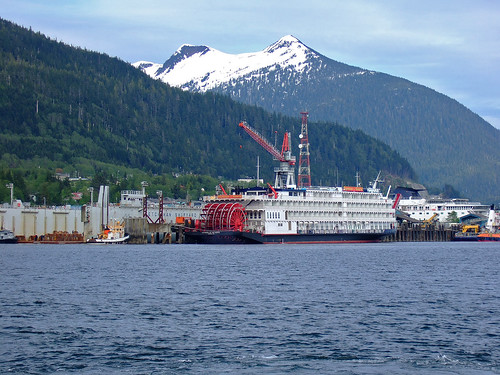
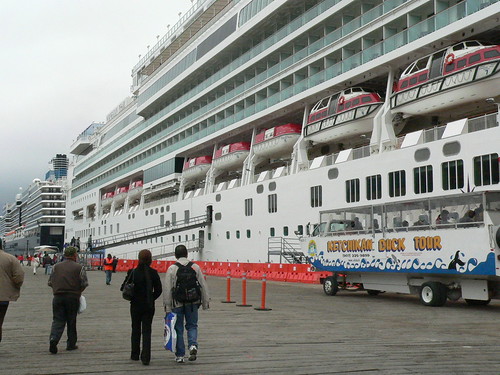
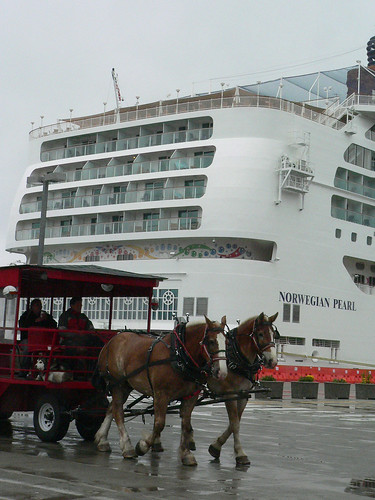
One of the first things we noticed were the huge cruise ships lined up along the waterfront. I had never seen a cruise ship up close and these were gigantic. Scott told us they have some cruise ships that span 14 decks. Catering to the tourists appears to be the major economic activity here. We saw flocks of tourists surging from shop to shop, a horse-drawn wagon making the rounds, and charter boats filled with hopeful anglers plying the waters of the harbor.

The landscape reminded me of the Oregon of my childhood before the timber companies stripped many of the hills trying to make a quick buck by selling raw logs to Japan. The hills around Ketchikan were a deep green with tall fir and cedars and the mountains capped with snow. Even though it was almost June the weather was cool and it sprinkled off and on. Ketchikan claims to be the 4th wettest place on earth with annual rainfall over 400 inches.

I also got a chance to find out how rough it can be living on an isolated island with only one main road. The first night I was there I somehow came down with a virus. I wretched all night and most of the next morning. I finally decided to go in to the emergency room but had to wait for my family to return from an awards ceremony so someone could drive me in. They didn't get home until 1 p.m. which was, unfortunately, after the highway department started blasting the road they were attempting to improve while the weather was decent. They also used a little too much dynamite and ended up blocking the entire road (the only road between me and the hospital) and knocking down the powerlines. Initially, they planned to have an ambulance go to the other side of the rock slide and send a gurney over for me. I was afraid it was going to be quite a spectacle! We waited for almost an hour and a half. Then someone else behind us suffered a severe allergic reaction and also needed to go to the hospital and was in a life-threatening state. So, the highway crew hurried as best they could and cleared just enough room for us to get by in the car (we were cautioned not to roll the windws down or have our arms outside the car though because the power lines were still dangling).

I finally got to the hospital about 4 p.m. only to find the ER jammed with patients waiting to be evacuated to Seattle. Apparently, the ferry's engines had quit and it floated away (with another ambulance on-board) and there was no way to get to the airport without it. The Coast Guard came to the rescue and lassoed the errant ferry and dragged it back to the dock. I finally got a bottle of IV fluid and an injection for nausea about 6 pm. The doctor said I pretty much just had to ride it out since nothing much could be done for a virus except rehydration so we went home.

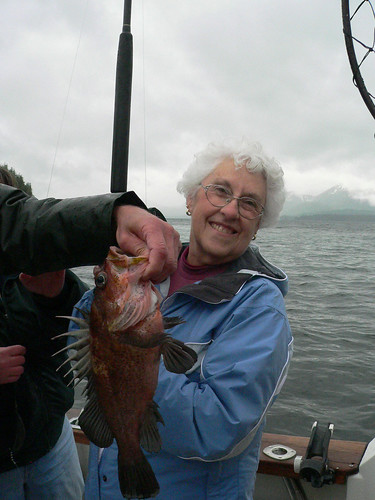
The next morning we were scheduled to go out on a charter boat. I was still a little shakey but I put my best foot forward, downed a sea-sickness pill, and headed for the dock. The charter boat captain was a friend of my niece and was quite welcoming. We trolled the inland passage hoping for a big King salmon but nothing much was biting in the gentle rain. The captain called in a bald eagle and pitched him some herring while I took pictures. Then we changed tactics and rigging and started fishing for rockfish and halibut. We managed to get several rockfish and just when it was almost time to go in, my brother-in-law, Ken, snagged a halibut. It was just a small one but I knew we'd have a delicious fish fry out of it.

That evening, my sister noticed an advertisement for a charity concert featuring "The Lettermen". They were popular when I was in high school. So, we changed clothes and headed for the auditorium. One of the original Lettermen was still in the group after 47 years of performances. He still sounded really good and his current fellow performers were wonderful too. We had a great time and even met them after the show. I thought to myself that I must have fallen into some time warp. This year I went to my first antiwar demonstration and my first Lettermen's concert thirty years after my 60s classmates had done those things!

The next day, my niece had scheduled a barbeque at Ward Lake Park. Since it is usually raining in Ketchikan, she had reserved a shelter just in case. Of course we needed it! We all huddled under the shelter while my nephew and his firehouse crewmates grilled hamburgers and hotdogs under the edge of the eaves. The local kids played out in the rain, throwing frisbees for their dog and splashing in the lake as if it was a sunny summer day.

Sunday, we all hustled down to the high school gymnasium to watch my niece receive her diploma. It was one of the best graduation ceremonies I have ever attended. Several of the seniors (including Jessica) got up and sang or played music. One very talented young man played music he had composed himself and conducted the high school band as well. The Tlingit Native American students wore their tribal ceremonial robes over the top of their cap-and-gowns and I noticed their parents and relatives did as well. Several of the seniors made the receipt of their diploma a particularly memorable event with acrobatics, skateboards, juggling, and, in Jessica's case, a march down the aisle dressed in her Dad's fireman's coat, hat , and boots. After all, she's a certified volunteer firefighter too!

On our last day, my nieces and sister took me to the Saxman Native Village where I learned about the Tlingit and Haida tribal histories, the importance of totems, and got a chance to participate in a tribal dance at the clan of the Beaver longhouse. I also toured the discovery center, the local historical museum, and had a delicious lunch up at the Inn at Cape Fox. Quite a grand finale! Have a look!

Monday, May 14, 2007

My "Adventure in Dreamland"

Today, I was reading an article about a New York Times film critic's "Adventure in Dreamland" about his family's trip to tinseltown and was disturbed by his comment about his trip to the Hollywood Entertainment Museum:

"We began with the Hollywood Entertainment Museum, which occupies a handsome Art Deco building that used to house the Max Factor makeup company. As I bought tickets, Justine pointed her digital camera at a poster in the lobby — an advertisement for the museum itself — and was immediately accosted by a man who seemed more like a junior production executive than the security guard he apparently was. “Ma'am, I'll have to ask you to erase that picture,” he said, explaining that “everything in this museum is a copyrighted piece of intellectual property.”

He didn't even mention the complete Cheers bar (look for where the stars carved their initials in the bar during the final episode) or that his kids were able to sit in the captain's chair of the original set from Star Trek: The Next Generation. He also didn't mention the series of interactive demonstration rooms that teach various tricks of filmmaking where, according to Frommer's guide, "visitors can create Foley soundtracks for a movie segment, test their skills at digital editing, and try out other fun, educational procedures."

I wonder if the rather rude reception his family received by the "security" guard left such a bad taste in his family's mouths that their enthusiasm for the museum's efforts were noticeably dampened. When I was there right after the facility opened in 1996, no one cared if you took pictures. I fear this is an example of the tact the MPAA is taking with all of the work they perceive as being so-called "protected" by copyright. Apparently they have learned nothing from the ridiculous antics of the music industry's RIAA and their attempted prosecution of "violators" as young as 12 years old. What a shame.

I was also saddened to hear that the place has become such a disorganized jumble of pictures and artifacts. At least when I was there I remember admiring some of the Egyptian miniatures used in the filming of the Ten Commandments and, of course, as a "Trekker" I got quite a thrill out of sitting in Captain Picard's chair and uttering "Make it So!". (The picture at left is me at the engineering console. At right I wait to consult with Captain Picard in his ready room). Time goes by so fast I guess I didn't realize that many of today's young people hardly remember "The Next Generation" since there has been three other series since then and the last, "Enterprise" had a relatively small viewership and has already passed into syndication on the Sci-Fi Channel.

I was also shocked by the price ($42) Warner Brothers charges for a less-than-two-hour backlot tour according to Mr. Scott's article. In 1996, I paid not much more than $46 for an entire day's pass to Universal Studios Hollywood. As I had already visited Universal Studios in Orlando, Florida, I was not as overwhelmed as I was on my first visit but I enjoyed the Waterworld show with the costumed "smokers" on jetskis and rode the "Jurassic Park" ride five times including once in the dark after dinner. (Fortunately, it was very hot so getting soaked by the water spouts and the final four-story plunge into a pool was refreshing.) The "Twister" tornado experience was interesting but short as was the "Backdraft" fire sequence. Of course, the Hollywood park also has the "Jaws" shark ride which is always fun even if you've done it before. I wish they would have had the "Revenge of the Mummy Ride" finished when I was there but I'll have to see it some other time.

Sunday, April 15, 2007

Maryhill Museum offers Fine Art to visitors of the Columbia Gorge

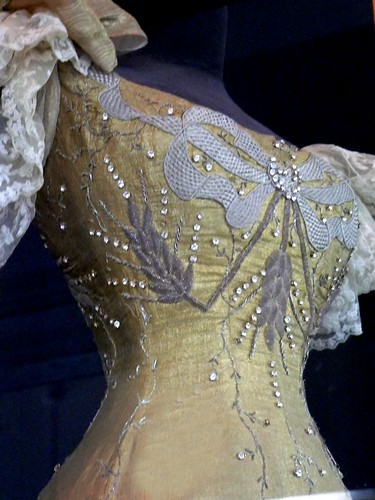
Although I have lived only five hours away from the Maryhill Museum that is across the Columbia River from The Dalles, Oregon, I didn't become one of the 10,000 visitors per month to the museum until the summer of 2006. I had heard Maryhill had a wonderful collection of European art and was home to a number of items from the estate of Queen Marie of Romania (including her coronation gown at left) but just hadn't gotten around to visiting it. Then, this past year the museum hosted a concert by the National Choir of Latvia from Riga and my sisters, brother and I decided to make the journey to Goldendale, Washington to attend the concert as a treat for our new sister-in-law from Riga. Gunta and my brother spend a month each year there and she is always anxious to share her culture with us.

First, a little history: Construction on the museum began in 1914 as a mansion for the wealthy entrepreneur Sam Hill.

"Samuel Hill was born to Quakers, an abolitionist physician and his wife, in North Carolina in 1857. At the end of the Civil War, the family moved to Minneapolis, Minnesota, where Hill grew up and where he attended Haverhill College. Upon graduation in 1878, Hill went to Harvard and received a second bachelor's degree in 1879.

He returned to Minneapolis and entered into a successful law practice in which he won significant verdicts against several of James J. Hill's (1838-1916) railroads (which became the Great Northern Railway). James J. Hill was so impressed with Sam's skill that he offered him a job that expanded into the presidency or directorship of a number of Hill's companies.

In 1888, Sam married James Hill's eldest daughter Mary. By the end of the nineteenth century, Sam Hill was a wealthy and accomplished railroad executive, financial manager, and investor, and he was active in a wide range of civic groups and fraternal organizations. He was noted for his tireless ambition and energy and for his integrity." - History Link.org


Sam named his estate Maryhill after his daughter, Mary. "But Hill apparently became irritated with Washington state officials for not completing a highway on the north bank of the Columbia and he abandoned the project in 1917." - History Link.org

One of Sam's friends, Loie Fuller (see a bronze of her at left by French sculptor, Theodore Louis-Auguste Riviere), an acclaimed Folies Bergere pioneer of modern dance, suggested to Sam that he convert his home into a museum, providing a cultural outpost in this rugged part of the Pacific Northwest. Using her contacts in Paris, Fuller made it possible for Sam to purchase a number of original Auguste Rodin sculptures to form the foundation for the new art center, including the only pedestal sized plaster version of the celebrated figure of The Thinker and a life sized plaster of Eve from the famed "Gates of Hell".

Sam traveled the world in his study and evaluation of railroads and highways and met many influential people, among them Queen Marie of Romania. During World War I, Sam extended generous support to the people of Romania. Afterwards, he invited Queen Marie of Romania to come to the United States and to dedicate his new museum when it was completed. Sadly, Sam Hill died in 1931 before it was completed. But, another friend, Alma Spreckels (of the San Francisco sugar company fame), having already founded the Legion of Honor Museum (the subject of another of my journeys) took up the mantle as chief benefactor of the budding Maryhill Museum. She donated many works of art from her own collection and with her guidance, the museum opened on Sam Hill's birthday, May 13, 1940.

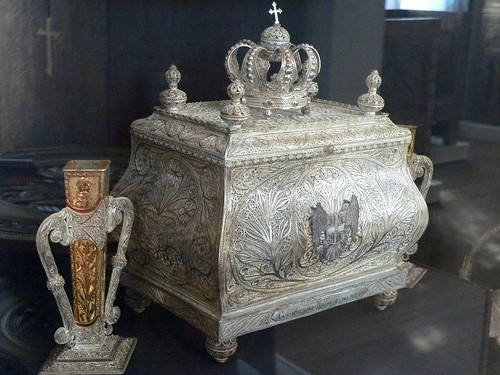
Upon her death, Queen Marie of Romania left a number of items from her personal estate including some uniquely beautiful Byzantine-styled furniture that she designed herself and her original audience chair. She also left her gold coronation gown and spectacular silver-filigreed chests and serving pieces that were given to her as wedding gifts. These items are displayed on the museum's main level along with a number of paintings from European masters.

The Rodin sculptures are displayed in a brightly lit gallery on the lower level along with an extensive collection of Native American baskets, clothing, and artifacts, many from the period of Lewis and Clark's Corps of Discovery expedition. Maryhill's Native American Collection began with a group of baskets acquired by Sam Hill but has grown through donations to over 800 baskets, encompassing virtually every North American basketry tradition and technical style, "from a tiny Pomo basket less than one inch in diameter to a four-foot-tall Apache storage Basket called an "olla".

"Maryhill Museum is located in the heart of the cultural region that anthropologists call the Plateau. Lying between the Rocky Mountains and the Cascade Range, the Plateau was peopled by seminomadic tribes who hunted and fished, and gathered wild roots and berries. The Plateau people were also excellent basket makers, and the Plateau collection at Maryhill is particularly noteworthy. Included are Wasco twined bags, twined cornhusk bags, and Klickitat and Interior Salish-style coiled baskets, as well as beaded bags and clothing, tools, utensils, toys, and games." - Maryhill Museum by Linda Brady Tesner.

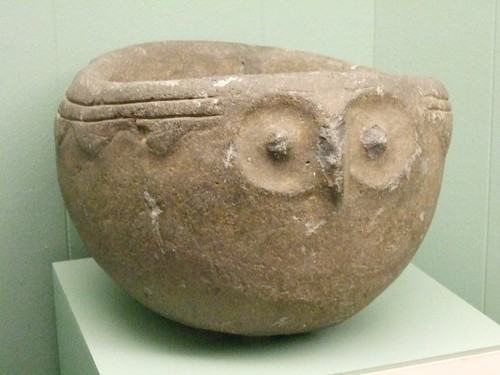
One of my favorite items was the 19th-century owl-shaped mortar bowl pictured at left.

Taking a brief rest, we ordered a delicious freshly-made sandwich from the small cafe Maryhill operates on the lower level. You can sit at tables provided there or take your lunch outside and enjoy the spectacular view of the Columbia River far below the bluff on which Maryhill rests.

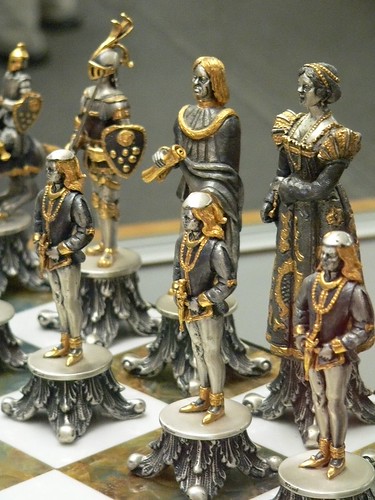
Maryhill also houses a chess set collection with over 500 examples of the strategy game from around the world that spans hundreds of years. The permanent collection is the result of an exhibit originally held in 1957. The exhibit was so popular that the then-curator Clifford Dolph decided to add these miniature works of art to the museum's permanent collection.

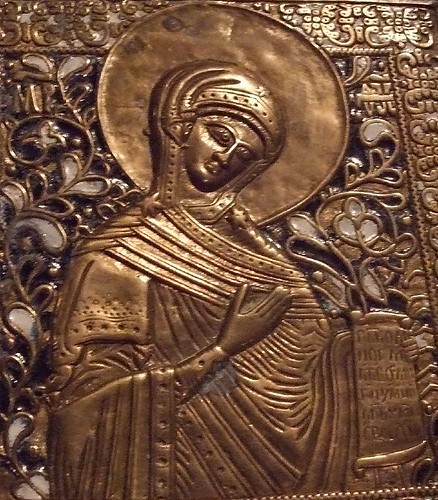
In the upper level of the museum, Russian Orthodox icons, many from the personal collection of Queen Marie of Romania, are displayed.

"The Russian Icons in Maryhill Museum's collection, like the Queen Marie royal regalia, shed light on the life and era of Maryhill's royal benefactor and speak to a religion and culture much different from that of the average American.

Queen Marie was the granddaughter of Tsar Alexander II; her mother, the Grand Duchess Marie and only daughter of Tsar Alexander II, married Prince Alfred of England, second son of Queen Victoria. While the marriage assured that Marie and her siblings would be raised in Victorian Great Britain and that the family would be trained in the church of England, the Russian Orthodox faith was part of Marie's life from an early age. Many of her childhood holidays were spent in Imperial Russia, where her relationships with her Romanov cousins exposed her to Orthodox rituals and religious artifacts.

Once Marie married Ferdinand, the Crown Prince of Roumania, Marie was obligated to adopt the Roumanian Orthodox faith and to promise to raise her children in the State Church. Her homes in Roumania were decorated with icons and other religious artifacts. Even in death, Marie held an icon of the Virgin.

In 1926 when Queen Marie ventured to the then-remote Pacific Northwest to dedicate Maryhill Museum for her friend Samuel Hill, she brought with her fifteen crates full of artwork and artifacts for the museum. Without doubt, some of the Maryhill Museum icons were in these crates.

To the Orthodox believer, these venerated objects provide a "window to heaven", a continuum which connects the secular world with the heavenly realm." - Maryhill Museum


More pictures of the objects in the permanent collection of Maryhill Museum

Friday, April 21, 2006

A Stroll Around the Tate Britain then Homeward Bound!


Tuesday, April 11, 2006:

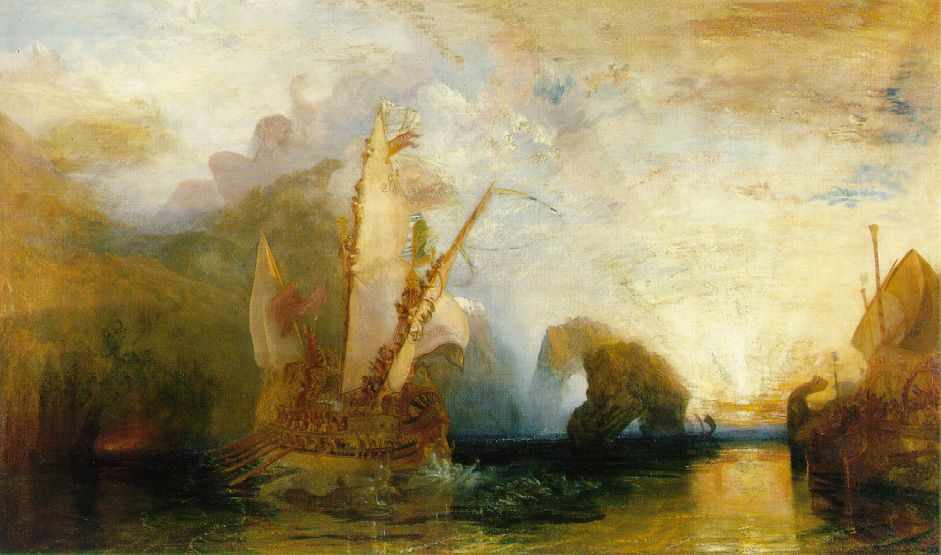
Today, we walked over to the Tate Britain and toured the wing devoted to one of our ancestors, JMW Turner. He paints mostly landscapes juxtaposing ancient ruins with contemporary country scenes or sea themes such as this work entitled " Ulysses deriding Polyphemus" in the style termed Romanticism which I find a little on the surreal side.

"Looking at Turner's pictures of the yellow dawn or the red of sunset, one is aware, perhaps for the first time in art, of the isolation of colour in itself. Even his sea-pieces contain flecks of bright unmodulated colour that enliven their at first sight more monochromatic treatment. To extract from the continuous range of light the purity of yellow, blue or red, the hues that command and comprise the rest, required an uncompromising integrity of vision. Turner had precisely 'the disposition to abstractions, to generalizing and classification' that Reynolds regarded as the great glory of the human mind, though in a form that Reynolds would hardly have recognised. Quite early in Turner's career his pictures were already accounted 'among the vagaries of a powerful genius rather than among the representations of nature'." - The ArtArchive

Often called "the painter of light" (and you thought that was Thomas Kinkade!) or the great pyrotechnist, Turner painted over 20,000 paintings over the course of his life. He exhibited his first work in the Royal Academy at the tender age of only 16 and was given full membership by the time he was 27.

Then we toured the work of British historical artists (much more my cup of tea). I saw the famous Lady of Shallot and works by famous portrait artists like George Romney. I also was introduced to works by John Everett Millais who is now on my favorites list. His statue graces the courtyard outside the Tate and I can see why!

Tomorrow its back to Heathrow and an 11 hour flight home over Iceland, Greenland, Hudson's Bay and beyond. It's going to be hard to pull myself back to the present after two weeks of immersion in another time and another place!

Forgive me if I use phrases you may not understand when I get back. I've learned that potato chips are called crisps and french fries are called chips. A baked potato is referred to as a "jacket" potato". Egg salad is called Egg Mayonnaise and often includes sprigs of watercress but if you want lettuce, tomato, etc. on your sandwich you say you want it with salad. However, if you order an egg and watercress sandwich, you get boiled egg and cress dry with no dressing at all. Salad here is often served with no dressing at all or only a hint of vinaigrette and Americans (including me) are notorious for wanting lots of ice with their beverages (usually they're served with no ice at all!)

I've learned that you won't find any "rubbish" bins in a train station so you have to carry your trash around with you until you can emerge from the underground and find a trash can. (security reasons). On our first trip out and about, we wandered around endlessly in Victoria station trying to find a trash can to dispose of our breakfast napkins until we finally asked a passerby. We thought we just didn't know what they looked like. I've learned that a mailbox here is referred to as a box but is in actuality a round red can-shaped receptacle. I've learned that if something is in good condition you say it is in "pretty good nick." And most importantly, I've learned when you need to go to the restroom you need to "pop the lu".

A Jaunt to York


Even though the tour company said it would take three hours by train we got to York in only two so we arrived at 9 a.m. We had been given tickets for the hop on, hop off city tour bus so we hopped on and rode up to the Jorvik Viking Center. It's sort of like the Epcot Center travel through time ride. They put you in a car on a track and you are taken on a winding ride through a Viking settlement. They are proud of their authentic surroundings and smells. Trust me - Viking settlements are really smelly! After you exit the ride you enter a small museum displaying artifacts and containing reenactors that demonstrate some of the ancient Viking handcrafts. The Jorvik center also had a great gift shop where I got some excellent books on Viking history and archaeology as well as some nice figures for my office (My office is really going to be heavily populated after this trip!)

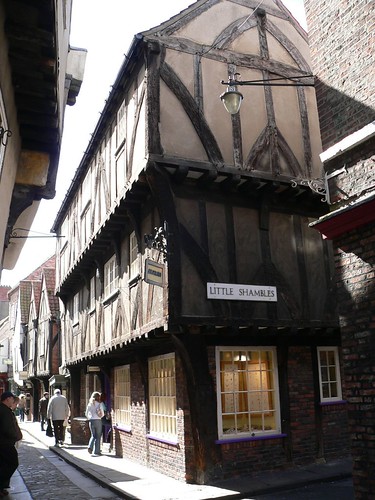
Then Jane and I wandered through the Shambles and we found several large antique shops that we had great fun exploring. Jane bought some half dolls and we each bought a 100-year old handmade miniature doll. Jane bought a lady in a very detailed gown while I bought a doll dressed as a Stuart-era gentleman in a tiny velvet suit with lace collar and cuffs, leather boots and gloves, and sporting a real beard and mustache. They are only about 1/2 doll house size (about 3" tall). I was also excited to find an authentic (certified) 4th century bronze Roman military cloak brooch in pretty good nick. We also came across a store that had small real metal Roman helmets complete with hinged cheekpieces and crest that I can display in my office (a bit too small for my head!) They had a life-sized vinyl Roman officer out front but I didn't want to buy another ticket home for him!

After lunch we walked over to Yorkminster Cathedral and I was surprised to discover that they are the first cathedral I have visited that actually allows photos in the sanctuary. I tried to be as unobtrusive as possible and only used the flash when I absolutely had to but got some nice shots both inside and outside. They even had some Tudor-era funerary effigies like those I saw at Westminster Abbey. I find the effigies a fascinating study in portraiture and historical fashion. Using my zoom lens, I was able to get closeups of some of the gargoyles high up on the ramparts. I was a little surprised, though, that they are really rather small. Of course the stained glass windows were very beautiful and I managed to get some good photos of some of the particularly detailed ones. If I had wanted to take pictures of all of them it would have taken me days! Jane talked with an artist apprentice out in front of the church that had rolled out the template for a new ceiling fresco he was working on in pastels that is a new addition to the church's artwork.

Jane waited upstairs (she didn't want to see anything dead) while I went down into the crypt but I really didn't see any tombs or coffins. The church authorities have displayed historical artifacts down there in museum-like display cases. The church is built over an old Roman fort and you can see the dais that was used by the commanding general to address his legions. They displayed busts of Vespasian and Septimus Severus who actually commanded troops in the area at one time and a bust of
Constantine that was actually unearthed in York. He doesn't resemble the formal busts in Rome at all!

The museum is set up so the displays begin with
Rome then progress to Saxon and Viking times and end with the establishment of Christianity. It also includes the silver ritual vessels used in church services over the centuries.

After we left the cathedral we walked toward the
York Museum Gardens where the Constantine the Great exhibit is on display. Jane was getting really tired and not particularly interested in the exhibit so I put her back on the tour bus and sent her back to the railway station while I went into the museum. Probably the most spectacular item in the exhibit was the Great Cameo depicting Constantine, his wife and children in a chariot pulled by prancing centaurs with Jupiter hovering over all. This huge cameo is about twice the size of a very large western-style cowboy belt buckle and is framed in gold encrusted with precious gems. I also toured the museum's permanent collection of Roman, Saxon, and Viking artifacts but my knees were about to give out on me so I didn't try to climb the stairs to the upper galleries that displayed local decorative arts.

I went out and caught the tour bus to get a ride back to the railway station but, of course, had to take the rest of the tour in the meantime (about 45 minutes). I learned about the famous local bandit Dick Turpin and saw the traitor's gate where the boiled and tarred heads of the town "bad boys" were displayed on spikes. We circled the medieval guild hall that is the oldest guild hall still in existence in Europe and were told all about the successful local "Kit Kat" candy bar factory (the guide even had us sing the Kit Kat advertising ditty!) We passed a very old church and learned about the small door called the "devil's door" on its west side. Apparently, back in medieval times, people believed that when a baby was baptized, the devil would then flee the child's body and needed a doorway to escape the church so each time a baby was christened this little door would be opened before the ceremony to accomodate the devil. The guide explained that most "devil's doors" were placed on the north side (the dark side) of the church but for some reason this little church had placed it on the west side. Of course
York has most of its original medieval city walls in tact and you can see the slits in the wall where they used to shoot arrows and pour boiling oil over their attackers. There is even a small portion of the original Roman wall still visible as well.

I caught up with Jane at the railway station and we caught the
6:00 p.m. train back to Kings Cross.