Showing posts with label museum. Show all posts

Sunday, December 21, 2008

Exploring Cabela's Animal Exhibits


My sister-in-law took me to my first Cabela's while on a visit to Minnesota back in the 1990s. When she first suggested going to an outdoor store I didn't know what could be so interesting as I'm not into camping or hunting. I didn't even bother to take my camera. So when we got there and I saw the spectacular animal exhibits I was awestruck and insisted we return the next day so I could photograph them. I returned the next day and shot pictures until my camera battery died. Since then I have made a point of visiting every Cabela's we have encountered in our travels. So far, we have visited Cabela's in Owatonna, Minnesota, Mitchell, South Dakota, Sidney, Nebraska, and Hamburg, Pennsylvania. I missed seeing the exhibits in the Lehi, Utah store by only one week (the store was brand new and wasn't going to be open for another week). And I could not find reasonably priced ground transportation to see the Cabela's on the outskirts of Fort Worth, Texas when I was there for an Educause conference a couple of years ago. Now I understand there are stores in Washington state and outside Boise, Idaho. I hope to visit them next summer.

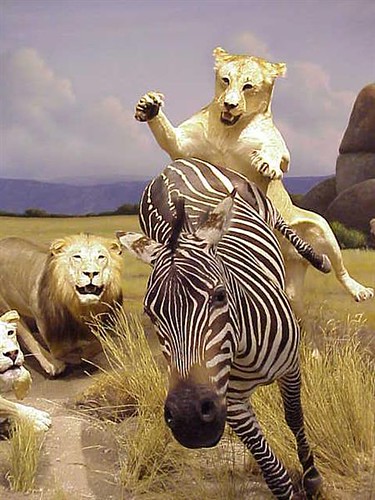
Cabela's does such an outstanding job of posing the animals in lifelike settings and engaged in lifelike movements that I found their exhibit far superior to the newly refurbished "Hall of Mammals" at the Smithsonian Museum of Natural History that I visited in 2004. Cabela's gave me an opportunity to become a virtual wildlife photographer without the travel and physical endurance required by expeditions to rugged and remote environments. The central mountain is illuminated by an overhead skylight so there is enough natural light to shoot many of the exhibits without flash, enabling you to capture the natural colors of the fur or feathers.
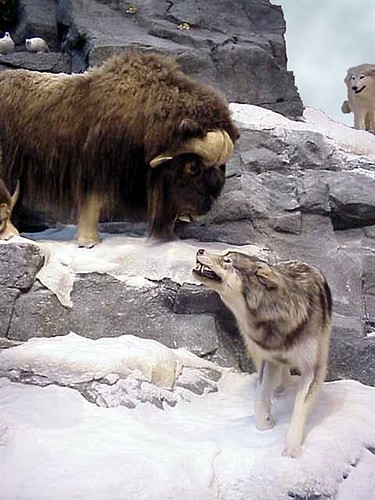
A fellow photographer up on Flickr disdainfully commented "but they're all dead!". Yes, that is true, but by preserving their natural beauty, Cabela's provides an opportunity to study the detail of each species and creates a learning environment unmatched by many museums. In fact, many surrounding schools take their students to Cabela's on field trips.

Cabela's also gives aspiring photographers an opportunity to compose images more artfully, and zoom in for the kind of closeup only a highly skilled "National Geographic-type" photographer can produce in the wild.
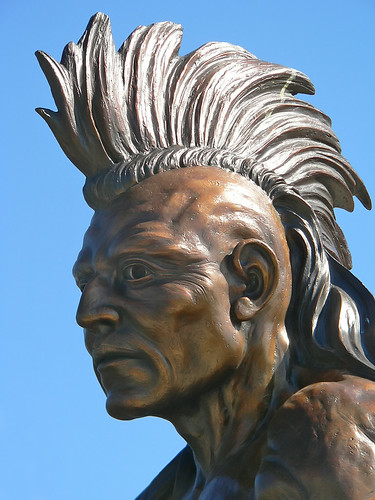
Each Cabela's store also displays a unique bronze sculpture in front of their store for art lovers like me to admire. This Native America warrior is paddling a canoe in front of the Cabela's store in Hamburg, Pennsylvania.

Cabela's usually place their stores in rural settings along interstate freeways so they are easy to access by car and are frequently advertised several miles in advance for the happenstance encounter. Cabela's provides ample parking and kennel service if you are traveling with a pet and the weather is either too hot or too cold to leave them in the car during your visit. They also house a restaurant so you can take all the time you want and not worry about what to do for breakfast, lunch, or supper.

I designed a website to display some of the beautiful exhibits I photographed on some of my first visits. Later, I uploaded my images to a Flickr photoset since I have taken literally hundreds of pictures and wanted to make them available to students and teachers for learning projects and exercises. All of my images are licensed with Creative Commons Attribution Share-Alike 2.0 permissions which grant the right to use them freely for noncommercial purposes as long as you include the credit "Photo by Mary Harrsch" and any derivatives are shared in a like manner.

Tuesday, August 14, 2007

A Virtual Visit to the Dresden State Museum of Art


My friend Kent Loobey sent me an article about the new Dresden State Museum of Art in Second Life and, of course, I had to go see it!

"The Dresden State Museum is one of Europe's oldest. Saxon kings began collecting art in the 1560s, but it wasn't until the reign of August the Strong, Elector of Saxony and King of Poland, in the early 1700s that art collection began in earnest. Augustus believed in putting his wealth on display. He and his heirs effectively created the first public museums in an effort to impress their subjects and fellow royals. In 1855, the Zwinger was expanded to create a gallery for the state art collection." - Wired

I launched Second Life and searched on Dresden under Art and Culture and clicked Teleport. In a few seconds my avatar was standing in the beautiful plaza surrounding the gallery. I walked over to the beautiful fountain and sat on the edge to look around and take in the beauty of my surroundings. Of course I couldn't help but have my picture taken there. Although Second Life has an in-world Snapshot tool, I prefer to use a simple Print Screen because the resulting frame is sharper and more detailed.

When I visit museums in real life I like to take pictures of the facade and any interesting architectural details that I see. Second Life's Camera Control tool lets me do the same thing - allowing me to pan and zoom in and zoom out to get a better look at anything that catches my eye.

Camera controls is not normally visible by default but if you click on View -> Camera Controls then you get a small interface that looks like two virtual joystick controllers with a ruler running vertically between them with a + at the top and a - at the bottom. Clicking on the + zooms in. If you reach the maximum zoom, try moving your avatar just a little closer to the object you are examinging to zoom in even more. Then use the joystick on the right to adjust the angle of your camera up, down, left, or right, and the joystick on the left to move the camera itself up, down, left, or right to eliminate any angular distortion.

I entered the main gallery and stopped at the desk and picked up a guest book SDK so I could record my impressions. The reception area is magnificent with its ornate domed ceilings, bas reliefs and sparkling chandeliers. It truly gives you the authentic feeling that you have entered a world-class museum!

Then I walked down the entryway and entered a room that featured some spectacular tapestries. Again I used my Camera Controls and my MouseLook view to pan around the room and zoom in on each piece of art to examine it more closely. The room had chairs arranged in it so you could sit and contemplate the art just like you would in the "real" gallery.


The tapestry room also featured a piano with a little script attached that you could click on to "play" it. My sound wasn't working right today but I think normally you would hear it. I crashed the Second Life application because I think I had too many applications open and probably should have rebooted. I'll have to try it again when I get a few spare moments. I had piano lessons when I was a child but haven't played in years. Based on my avatar's motions, the piano must have been magical as she appeared to play as well as a concert pianist!

I moved on to the next room where a number of interesting historical cityscapes captured my attention. I normally prefer images of people, both portraits and paintings of people engaged in interesting activities, but these scenes of 18th century city life were quite colorful and intriguing. I particularly liked this painting of the Marketplace at Pirna by Bernardo Bellotto (nephew of Canaletto) painted from 1753-1754 CE. (This image was taken using the Camera Controls and the PrintScreen key on my computer. Yes, the quality of the experience is that good!)

"Bernardo Bellotto, an Italian painter, was from Venice and the nephew and pupil of Canaletto. He was known for his townscapes (vedute). He is listed in the fraglia (Venetian painters' guild) from 1738 to 1743, by which latter date he had established his reputation. In 1747 he left Venice for Dresden and there in 1748 was appointed court painter to Frederick Augustus 11 of Saxony; in c1758 he was at Vienna working for Empress Maria Theresa; in 1761 he was working in Munich, after which he returned for a while to Dresden, before moving in 1767 to Warsaw to work for King Stanislas Poniatowski, staying there for the remainder of his life." - From "The Bulfinch Guide to Art History".

I then wandered into the next room and was rewarded by the vision of a beautiful portrait of
Princess Lubomirska, one time mistress of Augustus II (The Strong), Elector of Saxony and King of Poland, by Louis De Silvestre painted in 1724 CE.

"Louis de Silvestre was the son of Israël Silvestre. He was first apprenticed to his father, going on to study under Charles Le Brun and then Bon Boullogne. In 1694 he competed unsuccessfully for the Prix de Rome but left nevertheless for Italy. In Rome he met Carlo Maratti; he also visited Venice and Piedmont. On his return to Paris he was received (reçu) in 1702 into the Académie Royale, presenting the Creation of Man by Prometheus (Montpellier, Mus. Fabre). He embarked on a successful career, earning academic honours (he was appointed an assistant professor in 1704 and a full professor in 1706) and commissions from both the Church and the court. In 1703 he was commissioned by the guild of Paris goldsmiths to execute the May of Notre-Dame (Healing of the Sick, Arras, Mus. B.-A.). In 1709 he painted a Last Supper for the chapel at Versailles (in situ). This was followed by nine scenes from the Life of St Benedict (1709; examples in Paris, Louvre, see fig.; Béziers, Mus. B.-A.; Perpignan, Mus. Rigaud; Brussels, Mus. A. Anc.) for St Martin-des-Champs, and a St Matthew (1710; destr. 1748) for the cupola of St Roch, both in Paris. Among the secular works of his early career are the paintings originally intended for the Pavillon de la Ménagerie at Versailles, including Arion Playing the Lyre (1701; Compiègne, Château), and Hector Taking Leave of Andromache with its pendant Ulysses Taking Astyanax away from Andromache (both untraced), painted in 1708 for Armand-Gaston I de Rohan-Soubise (1674–1749); he also painted contemporary historical subjects (e.g. Battle of Kassel, Siege of Saint Omer; both untraced) for the funeral of Philippe I, Duc d’Orléans (d 1701)." - ArtNet.

I ran out of time for today's visit so I completed my comments statement in the space provided at the bottom of the Guestbook SDK I had received by touching the guest book in the reception area and returned to the guest book and dragged the SDK from my inventory over on top of the Guestbook on the table as instructed. Hopefully my comments were wisked away to the Dresden Gallery developers. I think this 3D experience gives the visitor much more of a feeling of "visiting" the museum than simply browsing through a well-illustrated book about the gallery. I hope other museums will follow Dresden's lead and provide many more such virtual galleries accessible to everyone (with access to a computer somewhere) regardless of their physical or financial ability to travel. I was certainly impressed!