When I go to Rome in October I will be staying at a converted monastery not far from the Colosseum. I didn't find my accommodations through the Monastery Stays website but I had heard that monasteries were available throughout Rome. Today, I stumbled across the Monastery Stays website and was quite excited to note their widespread availability throughout Italy and Sicily. Not only do their structures offer historical interest but for a woman traveling alone, they provide security and a quiet refuge after the end of a busy day of exploration. If you are into a wild nightlife, these accommodations are probably not your cup of tea since they have curfews ranging from 11 p.m. to midnight. But, I usually am so tired by 9 or 10 p.m. that their curfew policy does not pose a problem for me. I will definitely be visiting their website to arrange future accomodations!
Travel notes and photographs I have taken on my journeys to historical sites, national parks, historical homes, museums, gardens, theme parks, and just beautiful or interesting places.
Saturday, August 25, 2007
Monastery Stays offer affordable accommodations in historical surroundings
When I go to Rome in October I will be staying at a converted monastery not far from the Colosseum. I didn't find my accommodations through the Monastery Stays website but I had heard that monasteries were available throughout Rome. Today, I stumbled across the Monastery Stays website and was quite excited to note their widespread availability throughout Italy and Sicily. Not only do their structures offer historical interest but for a woman traveling alone, they provide security and a quiet refuge after the end of a busy day of exploration. If you are into a wild nightlife, these accommodations are probably not your cup of tea since they have curfews ranging from 11 p.m. to midnight. But, I usually am so tired by 9 or 10 p.m. that their curfew policy does not pose a problem for me. I will definitely be visiting their website to arrange future accomodations!
Tuesday, August 14, 2007
A Virtual Visit to the Dresden State Museum of Art

My friend Kent Loobey sent me an article about the new Dresden State Museum of Art in Second Life and, of course, I had to go see it!
"The Dresden State Museum is one of Europe's oldest. Saxon kings began collecting art in the 1560s, but it wasn't until the reign of August the Strong, Elector of Saxony and King of Poland, in the early 1700s that art collection began in earnest. Augustus believed in putting his wealth on display. He and his heirs effectively created the first public museums in an effort to impress their subjects and fellow royals. In 1855, the Zwinger was expanded to create a gallery for the state art collection." - Wired
I launched Second Life and searched on Dresden under Art and Culture and clicked Teleport. In a few seconds my avatar was standing in the beautiful plaza surrounding the gallery. I walked over to the beautiful fountain and sat on the edge to look around and take in the beauty of my surroundings. Of course I couldn't help but have my picture taken there. Although Second Life has an in-world Snapshot tool, I prefer to use a simple Print Screen because the resulting frame is sharper and more detailed.
When I visit museums in real life I like to take pictures of the facade and any interesting architectural details that I see. Second Life's Camera Control tool lets me do the same thing - allowing me to pan and zoom in and zoom out to get a better look at anything that catches my eye.
Camera controls is not normally visible by default but if you click on View -> Camera Controls then you get a small interface that looks like two virtual joystick controllers with a ruler running vertically between them with a + at the top and a - at the bottom. Clicking on the + zooms in. If you reach the maximum zoom, try moving your avatar just a little closer to the object you are examinging to zoom in even more. Then use the joystick on the right to adjust the angle of your camera up, down, left, or right, and the joystick on the left to move the camera itself up, down, left, or right to eliminate any angular distortion.

I entered the main gallery and stopped at the desk and picked up a guest book SDK so I could record my impressions. The reception area is magnificent with its ornate domed ceilings, bas reliefs and sparkling chandeliers. It truly gives you the authentic feeling that you have entered a world-class museum!

Then I walked down the entryway and entered a room that featured some spectacular tapestries. Again I used my Camera Controls and my MouseLook view to pan around the room and zoom in on each piece of art to examine it more closely. The room had chairs arranged in it so you could sit and contemplate the art just like you would in the "real" gallery.

The tapestry room also featured a piano with a little script attached that you could click on to "play" it. My sound wasn't working right today but I think normally you would hear it. I crashed the Second Life application because I think I had too many applications open and probably should
have rebooted. I'll have to try it again when I get a few spare moments. I had piano lessons when I was a child but haven't played in years. Based on my avatar's motions, the piano must have been magical as she appeared to play as well as a concert pianist!I moved on to the next room where a number of interesting historical cityscapes captured my attention. I normally prefer images of people, both portraits and paintings of people engaged in interesting activities, but these scenes of 18th century
city life were quite colorful and intriguing. I particularly liked this painting of the Marketplace at Pirna by Bernardo Bellotto (nephew of Canaletto) painted from 1753-1754 CE. (This image was taken using the Camera Controls and the PrintScreen key on my computer. Yes, the quality of the experience is that good!)"Bernardo Bellotto, an Italian painter, was from Venice and the nephew and pupil of Canaletto. He was known for his townscapes (vedute). He is listed in the fraglia (Venetian painters' guild) from 1738 to 1743, by which latter date he had established his reputation. In 1747 he left Venice for Dresden and there in 1748 was appointed court painter to Frederick Augustus 11 of Saxony; in c1758 he was at Vienna working for Empress Maria Theresa; in 1761 he was working in Munich, after which he returned for a while to Dresden, before moving in 1767 to Warsaw to work for King Stanislas Poniatowski, staying there for the remainder of his life." - From "The Bulfinch Guide to Art History".
I then wandered into the next room and was rewarded by the vision of a beautiful portrait of Princess Lubomirska, one time mistress of Augustus II (The Strong), Elector of Saxony and King of Poland, by Louis De Silvestre painted in 1724 CE.

"Louis de Silvestre was the son of Israël Silvestre. He was first apprenticed to his father, going on to study under Charles Le Brun and then Bon Boullogne. In 1694 he competed unsuccessfully for the Prix de Rome but left nevertheless for Italy. In Rome he met Carlo Maratti; he also visited Venice and Piedmont. On his return to Paris he was received (reçu) in 1702 into the Académie Royale, presenting the Creation of Man by Prometheus (Montpellier, Mus. Fabre). He embarked on a successful career, earning academic honours (he was appointed an assistant professor in 1704 and a full professor in 1706) and commissions from both the Church and the court. In 1703 he was commissioned by the guild of Paris goldsmiths to execute the May of Notre-Dame (Healing of the Sick, Arras, Mus. B.-A.). In 1709 he painted a Last Supper for the chapel at Versailles (in situ). This was followed by nine scenes from the Life of St Benedict (1709; examples in Paris, Louvre, see fig.; Béziers, Mus. B.-A.; Perpignan, Mus. Rigaud; Brussels, Mus. A. Anc.) for St Martin-des-Champs, and a St Matthew (1710; destr. 1748) for the cupola of St Roch, both in Paris. Among the secular works of his early career are the paintings originally intended for the Pavillon de la Ménagerie at Versailles, including Arion Playing the Lyre (1701; Compiègne, Château), and Hector Taking Leave of Andromache with its pendant Ulysses Taking Astyanax away from Andromache (both untraced), painted in 1708 for Armand-Gaston I de Rohan-Soubise (1674–1749); he also painted contemporary historical subjects (e.g. Battle of Kassel, Siege of Saint Omer; both untraced) for the funeral of Philippe I, Duc d’Orléans (d 1701)." - ArtNet.
I ran out of time for today's visit so I completed my comments statement in the space provided at the bottom of the Guestbook SDK I had received by touching the guest book in the reception area and returned to the guest book and dragged the SDK from my inventory over on top of the Guestbook on the table as instructed. Hopefully my comments were wisked away to the Dresden Gallery developers. I think this 3D experience gives the visitor much more of a feeling of "visiting" the museum than simply browsing through a well-illustrated book about the gallery. I hope other museums will follow Dresden's lead and provide many more such virtual galleries accessible to everyone (with access to a computer somewhere) regardless of their physical or financial ability to travel. I was certainly impressed!
Monday, August 13, 2007
I wish I had seen Yorktown when we visited Williamsburg
Friday, June 15, 2007
North to Alaska
For years, my relatives in Alaska have been pleading with us to come up and see their beautiful part of the country. We finally did at the end of May to help my great niece, Jessica Davis, celebrate her graduation from high school.
My great niece lives with her parents, Scott and Traci Davis, in Ketchikan. My oldest sister has made a number of trips to Ketchikan and returned with great fish stories (supported by boxes of delicious halibut and smoked salmon) and other tales from the land of the midnight sun. So, it was finally time to see for ourselves.
We arrived by plane from Seattle and boarded the ferry to take us across the inland passage to the island where Ketchikan stretches along its shoreline.
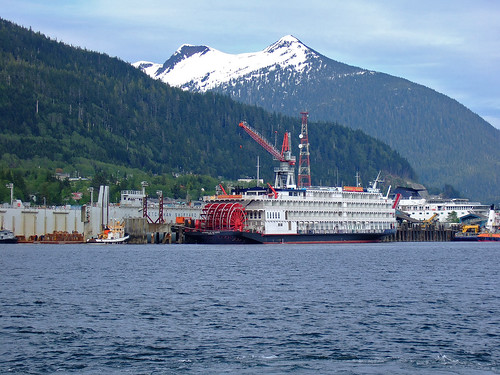
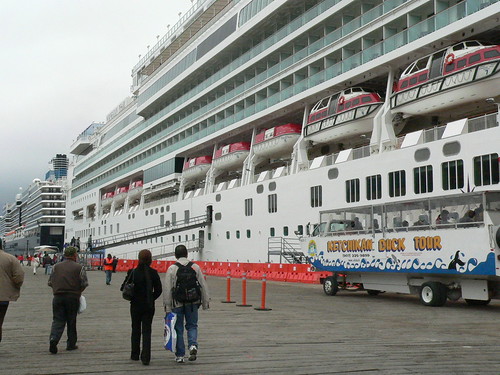
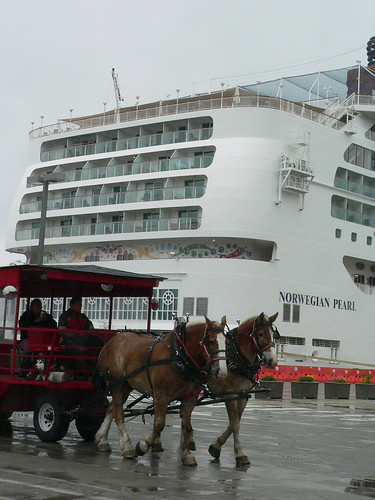
One of the first things we noticed were the huge cruise ships lined up along the waterfront. I had never seen a cruise ship up close and these were gigantic. Scott told us they have some cruise ships that span 14 decks. Catering to the tourists appears to be the major economic activity here. We saw flocks of tourists surging from shop to shop, a
The landscape reminded me of the Oregon of my childhood before the timber companies stripped many of the hills trying to make a quick buck by selling raw logs to Japan. The hills around Ketchikan were a deep green with tall fir and cedars and the mountains capped with snow. Even though it was almost June the weather was cool and it sprinkled off and on. Ketchikan claims to be the 4th wettest place on earth with annual rainfall over 400 inches.
I also got a chance to find out how rough it can be living on an isolated island with only one main road. The first night I was there I somehow came down with a virus. I wretched all night and most of the next morning. I finally decided to go in to the emergency room but had to wait for my family to return from an awards ceremony so someone could drive me in. They didn't get home until 1 p.m. which was, unfortunately, after the highway department started blasting the road they were attempting to improve while the weather was decent. They also used a little too much dynamite and ended up blocking the entire road (the only road between me and the hospital) and knocking down the powerlines. Initially, they planned to have an ambulance go to the other side of the rock slide and send a gurney over for me. I was afraid it was going to be quite a spectacle! We waited for almost an hour and a half. Then someone else behind us suffered a severe allergic reaction and also needed to go to the hospital and was in a life-threatening state. So, the highway crew hurried as best they could and cleared just enough room for us to get by in the car (we were cautioned not to roll the windws down or have our arms outside the car though because the power lines were still dangling).
I finally got to the hospital about 4 p.m. only to find the ER jammed with patients waiting to be evacuated to Seattle. Apparently, the ferry's engines had quit and it floated away (with another ambulance on-board) and there was no way to get to the airport without it. The Coast Guard came to the rescue and lassoed the errant ferry and dragged it back to the dock. I finally got a bottle of IV fluid and an injection for nausea about 6 pm. The doctor said I pretty much just had to ride it out since nothing much could be done for a virus except rehydration so we went home.
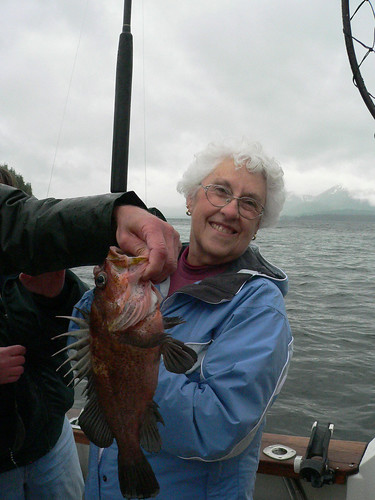
The next morning we were scheduled to go out on a charter boat. I was still a little shakey but I put my best foot forward, downed a sea-sickness pill, and headed for the dock. The charter boat captain was a friend
That evening, my sister noticed an advertisement for a charity concert featuring "The Lettermen". They were popular when I was in high school. So, we changed clothes and headed for the auditorium. One of the original Lettermen was still in the group after 47 years of performances. He still sounded really good and his current fellow performers were wonderful too. We had a great time and even met them after the show. I thought to myself that I must have fallen into some time warp. This year I went to my first antiwar demonstration and my first Lettermen's concert thirty years after my 60s classmates had done those things!
The next day, my niece had scheduled a barbeque at Ward Lake Park. Since it is usually raining in Ketchikan, she had reserved a shelter just in case. Of course we needed it! We all huddled under the shelter while my nephew and his firehouse crewmates grilled hamburgers and hotdogs under the edge of the eaves. The local kids played out in the rain, throwing frisbees for their dog and splashing in the lake as if it was a sunny summer day.
Sunday, we all hustled down to the high school gymnasium to watch my niece receive her diploma. It was one of the best graduation ceremonies I have ever attended. Several of the seniors (including Jessica) got up and sang or played music. One very talented young man played music he had composed himself and conducted the high school band as well. The Tlingit Native American students wore their tribal ceremonial robes over the top of their cap-and-gowns and I noticed their parents and relatives did as well. Several of the seniors made the receipt of their diploma a particularly memorable event with acrobatics, skateboards, juggling, and, in Jessica's case, a march down the aisle dressed in her Dad's fireman's coat, hat , and boots. After all, she's a certified volunteer firefighter too!
On our last day, my nieces and sister took me to the Saxman Native Village where I learned about the Tlingit and Haida tribal histories, the importance of totems, and got a chance to participate in a tribal dance at the clan of the Beaver longhouse. I also toured the discovery center, the local historical museum, and had a delicious lunch up at the Inn at Cape Fox. Quite a grand finale! Have a look!
Monday, May 14, 2007
My "Adventure in Dreamland"
"We began with the Hollywood Entertainment Museum, which occupies a handsome Art Deco building that used to house the Max Factor makeup company. As I bought tickets, Justine pointed her digital camera at a poster in the lobby — an advertisement for the museum itself — and was immediately accosted by a man who seemed more like a junior production executive than the security guard he apparently was. “Ma'am, I'll have to ask you to erase that picture,” he said, explaining that “everything in this museum is a copyrighted piece of intellectual property.”
He didn't even mention the complete Cheers bar (look for where the stars carved their initials in the bar during the final episode) or that his kids were able to sit in the captain's chair of the original set from Star Trek: The Next Generation. He also didn't mention the series of interactive demonstration rooms that teach various tricks of filmmaking where, according to Frommer's guide, "visitors can create Foley soundtracks for a movie segment, test their skills at digital editing, and try out other fun, educational procedures."
I wonder if the rather rude reception his family received by the "security" guard left such a bad taste in his family's mouths that their enthusiasm for the museum's efforts were noticeably dampened. When I was there right after the facility opened in 1996, no one cared if you took pictures. I fear this is an example of the tact the MPAA is taking with all of the work they perceive as being so-called "protected" by copyright. Apparently they have learned nothing from the ridiculous antics of the music industry's RIAA and their attempted prosecution of "violators" as young as 12 years old. What a shame.
I was also shocked by the price ($42) Warner Brothers charges for a less-than-two-hour backlot tour according to Mr. Scott's article. In 1996, I paid not much more than $46 for an entire day's pass to Universal Studios Hollywood. As I had already visited Universal Studios in Orlando, Florida, I was not as overwhelmed as I was on my first visit but I enjoyed the Waterworld show with the costumed "smokers" on jetskis and rode the "Jurassic Park" ride five times including once in the dark after dinner. (Fortunately, it was very hot so getting soaked by the water spouts and the final four-story plunge into a pool was refreshing.) The "Twister" tornado experience was interesting but short as was the "Backdraft" fire sequence. Of course, the Hollywood park also has the "Jaws" shark ride which is always fun even if you've done it before. I wish they would have had the "Revenge of the Mummy Ride" finished when I was there but I'll have to see it some other time.
Sunday, April 15, 2007
Maryhill Museum offers Fine Art to visitors of the Columbia Gorge
First, a little history: Construction on the museum began in 1914 as a mansion for the wealthy entrepreneur Sam Hill.
"Samuel Hill was born to Quakers, an abolitionist physician and his wife, in North Carolina in 1857. At the end of the Civil War, the family moved to Minneapolis, Minnesota, where Hill grew up and where he attended Haverhill College. Upon graduation in 1878, Hill went to Harvard and received a second bachelor's degree in 1879.
He returned to Minneapolis and entered into a successful law practice in which he won significant verdicts against several of James J. Hill's (1838-1916) railroads (which became the Great Northern Railway). James J. Hill was so impressed with Sam's skill that he offered him a job that expanded into the presidency or directorship of a number of Hill's companies.
In 1888, Sam married James Hill's eldest daughter Mary. By the end of the nineteenth century, Sam Hill was a wealthy and accomplished railroad executive, financial manager, and investor, and he was active in a wide range of civic groups and fraternal organizations. He was noted for his tireless ambition and energy and for his integrity." - History Link.org
Sam named his estate Maryhill after his daughter, Mary. "But Hill apparently became irritated with Washington state officials for not completing a highway on the north bank of the Columbia and he abandoned the project in 1917." - History Link.org
One of Sam's friends, Loie Fuller (see a bronze of her at left by French sculptor, Theodore Louis-Auguste Riviere), an acclaimed Folies Bergere pioneer of modern dance, suggested to Sam that he convert his home into a museum, providing a cultural outpost in this rugged part of the Pacific Northwest. Using her contacts in Paris, Fuller made it possible for Sam to purchase a number of original Auguste Rodin
Sam traveled the world in his study and evaluation of railroads and highways and met many influential people, among them Queen Marie of Romania. During World War I, Sam extended generous support to the people of Romania. Afterwards, he invited Queen Marie of Romania to come to the United States and to dedicate his new museum when it was completed. Sadly, Sam Hill died in 1931 before it was completed. But, another friend, Alma Spreckels (of the San Francisco sugar
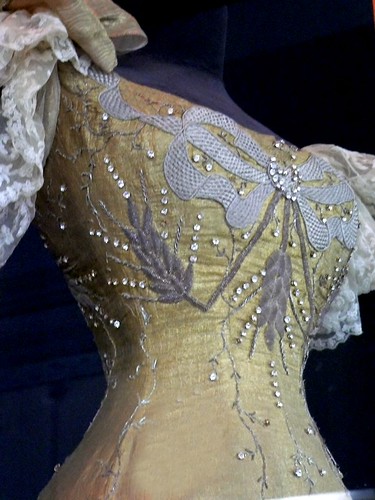
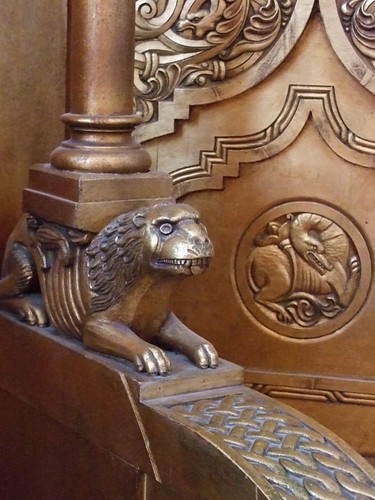
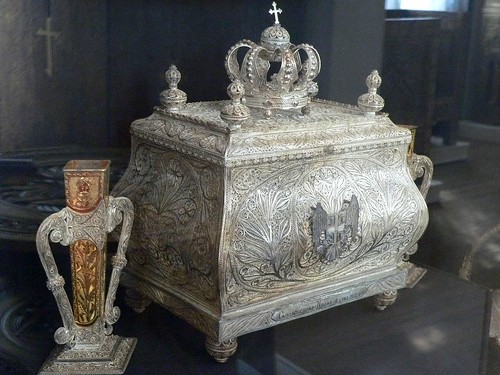
Upon her death, Queen Marie of Romania left a number of items from her personal estate including some uniquely beautiful Byzantine-styled furniture that she designed herself and her original audience chair. She also left her gold coronation gown and
The Rodin sculptures are displayed in a brightly lit gallery on the lower level along with an extensive collection of Native American baskets, clothing, and artifacts, many from the period of Lewis and Clark's Corps of Discovery expedition. Maryhill's Native American Collection began with a group of baskets acquired by Sam Hill but has grown through donations to over 800 baskets, encompassing virtually every North American basketry tradition and technical style, "from a tiny Pomo basket less than one inch in diameter to a four-foot-tall Apache storage Basket called an "olla".
"Maryhill Museum is located in the heart of the cultural region that anthropologists call the Plateau. Lying between the Rocky Mountains and the Cascade Range, the Plateau was peopled by seminomadic tribes who hunted and fished, and gathered wild roots and berries. The Plateau people were also excellent basket makers, and the Plateau collection at Maryhill is particularly noteworthy.
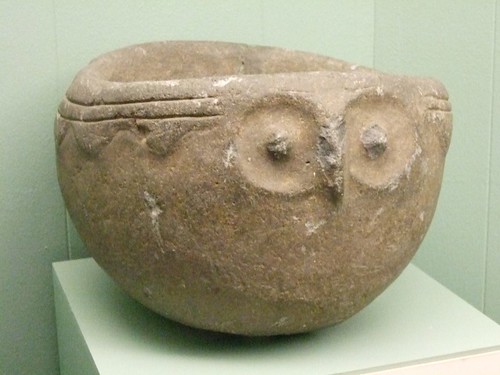
One of my favorite items was the 19th-century owl-shaped mortar bowl pictured at left.
Taking a brief rest, we ordered a delicious freshly-made sandwich from the small cafe Maryhill operates on the lower level. You can sit at tables provided there or take your lunch outside and enjoy the spectacular view of the Columbia River far below the bluff on which Maryhill rests.
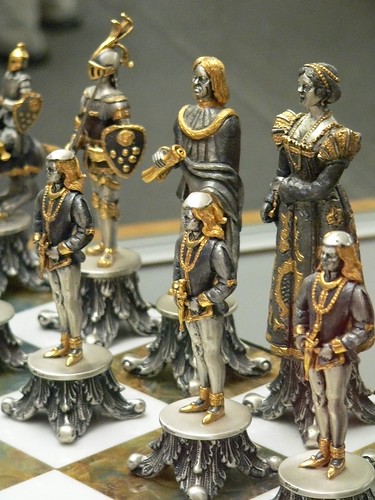
Maryhill also houses a chess set collection with over 500 examples of the strategy game from around the world that spans hundreds of years.
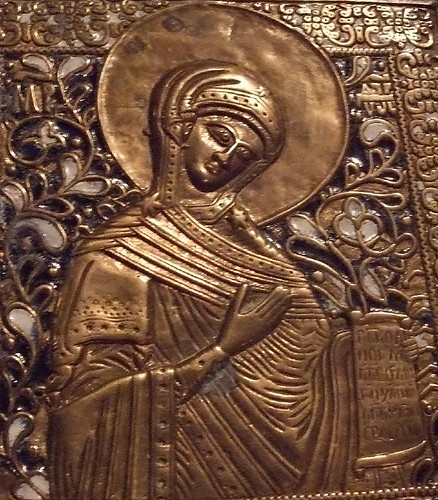
In the upper level of the museum, Russian Orthodox icons, many from the personal collection of Queen Marie of Romania, are displayed.
"The Russian Icons in Maryhill Museum's collection, like the Queen Marie royal regalia, shed light on the life and era of Maryhill's royal benefactor and speak to a religion and culture much different from that of the average American.
Queen Marie was the granddaughter of Tsar Alexander II; her mother, the Grand Duchess Marie and only daughter of Tsar Alexander II, married Prince Alfred of England, second son of Queen Victoria. While the marriage assured that Marie and her siblings would be raised in Victorian Great Britain and that the family would be trained in the church of England, the Russian Orthodox faith was part of Marie's life from an early age. Many of her childhood holidays were spent in Imperial Russia, where her relationships with her Romanov cousins exposed her to Orthodox rituals and religious artifacts.
Once Marie married Ferdinand, the Crown Prince of Roumania, Marie was obligated to adopt the Roumanian Orthodox faith and to promise to raise her children in the State Church. Her homes in Roumania were decorated with icons and other religious artifacts. Even in death, Marie held an icon of the Virgin.
In 1926 when Queen Marie ventured to the then-remote Pacific Northwest to dedicate Maryhill Museum for her friend Samuel Hill, she brought with her fifteen crates full of artwork and artifacts for the museum. Without doubt, some of the Maryhill Museum icons were in these crates.
To the Orthodox believer, these venerated objects provide a "window to heaven", a continuum which connects the secular world with the heavenly realm." - Maryhill Museum
More pictures of the objects in the permanent collection of Maryhill Museum
Friday, April 21, 2006
A Stroll Around the Tate Britain then Homeward Bound!
Tuesday, April 11, 2006:
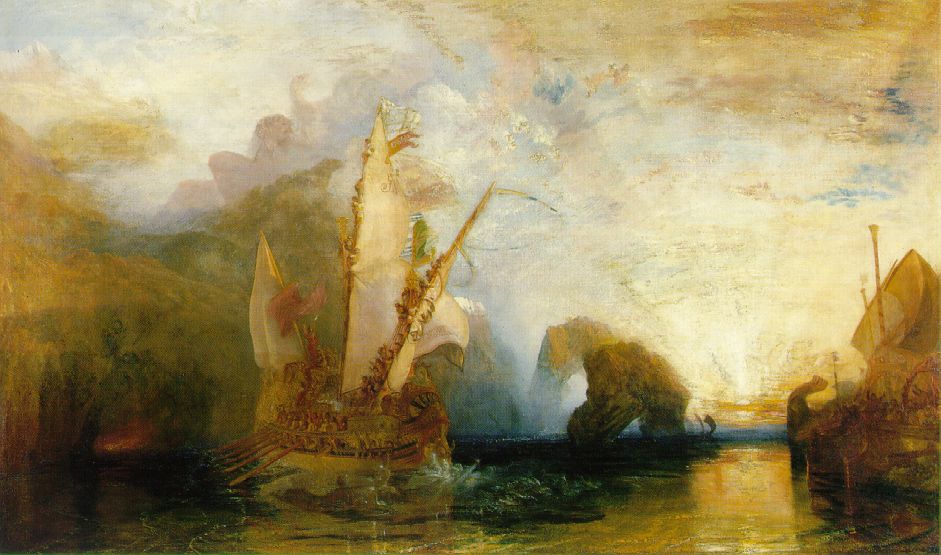
Today, we walked over to the Tate Britain and toured the wing devoted to one of our ancestors, JMW Turner. He paints mostly landscapes juxtaposing ancient ruins with contemporary country scenes or sea themes such as this work entitled " Ulysses deriding Polyphemus" in the style termed Romanticism which I find a little on the surreal side.
"Looking at Turner's pictures of the yellow dawn or the red of sunset, one is aware, perhaps for the first time in art, of the isolation of colour in itself. Even his sea-pieces contain flecks of bright unmodulated colour that enliven their at first sight more monochromatic treatment. To extract from the continuous range of light the purity of yellow, blue or red, the hues that command and comprise the rest, required an uncompromising integrity of vision. Turner had precisely 'the disposition to abstractions, to generalizing and classification' that Reynolds regarded as the great glory of the human mind, though in a form that Reynolds would hardly have recognised. Quite early in Turner's career his pictures were already accounted 'among the vagaries of a powerful genius rather than among the representations of nature'." - The ArtArchive
Often called "the painter of light" (and you thought that was Thomas Kinkade!) or the great pyrotechnist, Turner painted over 20,000 paintings over the course of his life. He exhibited his first work in the Royal Academy at the tender age of only 16 and was given full membership by the time he was 27.
Then we toured the work of British historical artists (much more my cup of tea). I saw the famous Lady of Shallot and works by famous portrait artists like George Romney. I also was introduced to works by John Everett Millais who is now on my favorites list. His statue graces the courtyard outside the Tate and I can see why!
Tomorrow its back to Heathrow and an 11 hour flight home over
Forgive me if I use phrases you may not understand when I get back. I've learned that potato chips are called crisps and french fries are called chips. A baked potato is referred to as a "jacket" potato". Egg salad is called Egg Mayonnaise and often includes sprigs of watercress but if you want lettuce, tomato, etc. on your sandwich you say you want it with salad. However, if you order an egg and watercress sandwich, you get boiled egg and cress dry with no dressing at all. Salad here is often served with no dressing at all or only a hint of vinaigrette and Americans (including me) are notorious for wanting lots of ice with their beverages (usually they're served with no ice at all!)
I've learned that you won't find any "rubbish" bins in a train station so you have to carry your trash around with you until you can emerge from the underground and find a trash can. (security reasons). On our first trip out and about, we wandered around endlessly in
A Jaunt to York
Even though the tour company said it would take three hours by train we got to
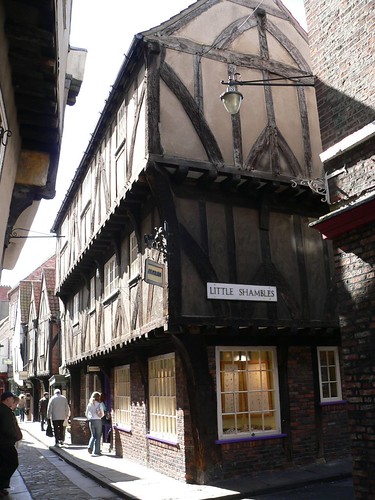
Then Jane and I wandered through the Shambles and we found several large antique shops that we had great fun exploring. Jane bought some half dolls and we each bought a 100-year old handmade miniature doll. Jane bought a lady in a very detailed gown while I bought a doll dressed as a Stuart-era gentleman in a tiny velvet suit with lace collar and cuffs, leather boots and gloves, and sporting a real beard and mustache. They are only about 1/2 doll house size (about 3" tall). I was also excited to find an authentic (certified) 4th century bronze Roman military cloak brooch in pretty good nick. We also came across a store that had small real metal Roman helmets complete with hinged cheekpieces and crest that I can display in my office (a bit too small for my head!) They had a life-sized vinyl Roman officer out front but I didn't want to buy another ticket home for him!
After lunch we walked over to Yorkminster Cathedral and I was surprised to discover that they are the first cathedral I have visited that actually allows photos in the sanctuary. I tried to be as unobtrusive as possible and only used the flash when I absolutely had to but got some nice shots both inside and outside. They even had some Tudor-era funerary effigies like those I saw at Westminster Abbey. I find the effigies a fascinating study in portraiture and historical fashion. Using my zoom lens, I was able to get closeups of some of the gargoyles high up on the ramparts. I was a little surprised, though, that they are really rather small. Of course the stained glass windows were very beautiful and I managed to get some good photos of some of the particularly detailed ones. If I had wanted to take pictures of all of them it would have taken me days! Jane talked with an artist apprentice out in front of the church that had rolled out the template for a new ceiling fresco he was working on in pastels that is a new addition to the church's artwork.
Jane waited upstairs (she didn't want to see anything dead) while I went down into the crypt but I really didn't see any tombs or coffins. The church authorities have displayed historical artifacts down there in museum-like display cases. The church is built over an old Roman fort and you can see the dais that was used by the commanding general to address his legions. They displayed busts of Vespasian and Septimus Severus who actually commanded troops in the area at one time and a bust of
The museum is set up so the displays begin with
After we left the cathedral we walked toward the
I went out and caught the tour bus to get a ride back to the railway station but, of course, had to take the rest of the tour in the meantime (about 45 minutes). I learned about the famous local bandit Dick Turpin and saw the traitor's gate where the boiled and tarred heads of the town "bad boys" were displayed on spikes. We circled the medieval guild hall that is the oldest guild hall still in existence in Europe and were told all about the successful local "Kit Kat" candy bar factory (the guide even had us sing the Kit Kat advertising ditty!) We passed a very old church and learned about the small door called the "devil's door" on its west side. Apparently, back in medieval times, people believed that when a baby was baptized, the devil would then flee the child's body and needed a doorway to escape the church so each time a baby was christened this little door would be opened before the ceremony to accomodate the devil. The guide explained that most "devil's doors" were placed on the north side (the dark side) of the church but for some reason this little church had placed it on the west side. Of course
I caught up with Jane at the railway station and we caught the
Madame Tussaud's, Westminster Abbey, Stonehenge, and Roman Bath
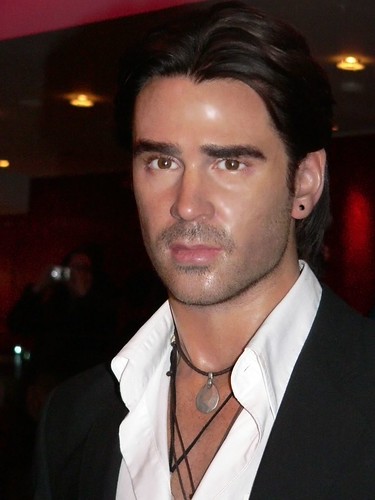
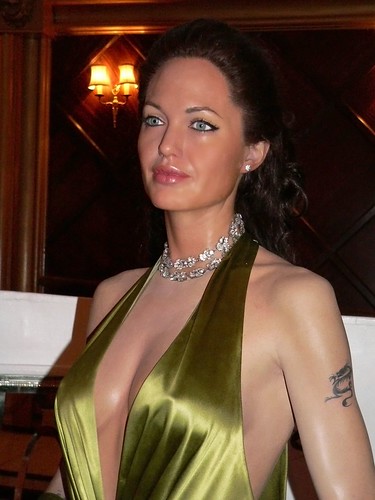
Monday, April 10, 2006: I can't remember where I left off so I'll start with Wednesday. Wednesday we had passes to Madame Tussaud's wax museum. As expected the wax figures were the best I have ever seen. Of course the Tom Cruise was one of the most popular (for me and my sister
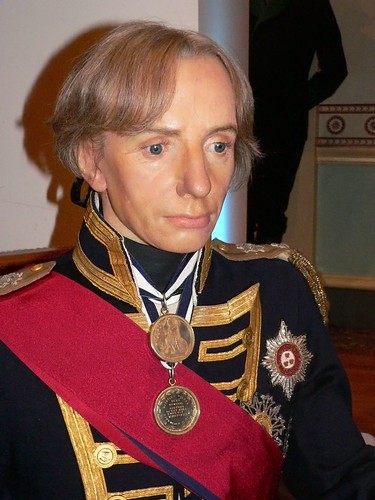
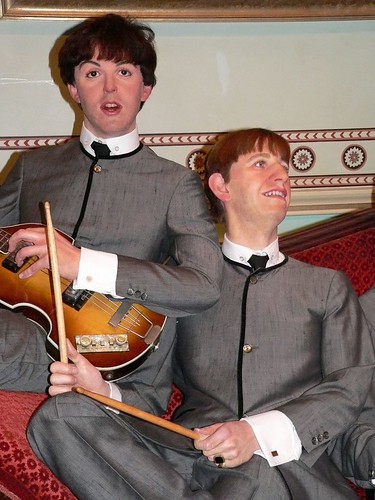
In the world showcase, I was surprised that the most popular figures tourists were posing with were Adolph Hitler and Fidel Castro!!?? I preferred Admiral Lord Nelson myself! I had hoped to photograph Henry the VIII and Elizabeth but they had been removed temporarily to make room for a photo setup with Queen Elizabeth, Phillip and Prince Charles. The Pope John Paul II figure was very elaborate and a lot of rather silver-haired
and somewhat wrinkled women (does that describe me?) were posing with the Beatles.
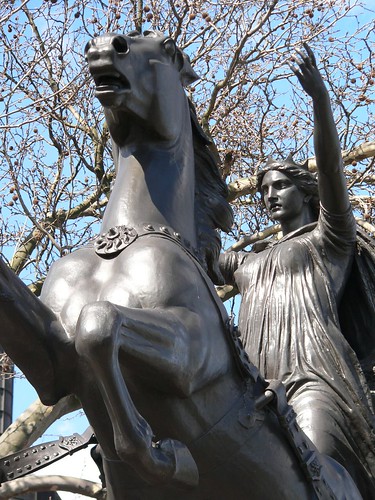
After leaving Madame Tussaud's we caught the train back to to see the famous statue of Boudicca, the warrior queen of the Iceni tribe who rebelled against the Romans in 62 CE. Prior to this time, the Iceni had coexisted with the Romans and Boudicca's husband Prasutagus was a client King. However, when Prasutagus died, the Roman governor of the region decided to seize her land and had Boudicca flogged and her daughters raped as a lesson in power. He discovered he had made a major mistake. She and her followers succeeded in burning down Camulodunum (modern day Colchester), Londonium, and Verulamium (the Roman site I will visit Saturday at St. Alban's).
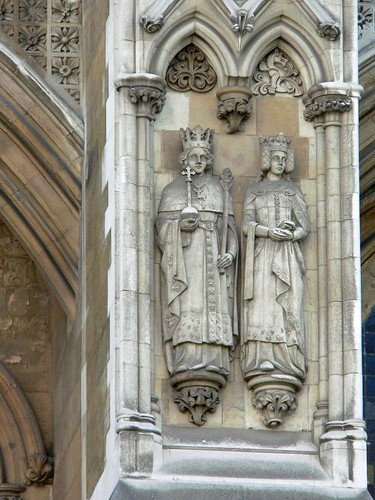
We pressed on to Westminster Abbey. It was so huge and filled with so many memorials that it took us the rest of the day. I was particularly interested in the tomb effigy of Elizabeth I. The face was sculpted from her actual death mask. I was also surprised to learn that her sister Mary (daughter of Henry and Catherine of Aragon) is interred with her, and is engraved with a very loving inscription written by
Thursday, we went on a guided tour to
We accidentally waited for the tour bus on the wrong side of the Abbey where it let us off and the driver didn't see us so we almost got left. Jane's friend called the office and they had the bus come back for us. Unfortunately it made us late for
Friday, we thought we were going to have a relaxing day over at the
I was also dumbfounded by the size of a jousting lance. Although it was designed with flutes to ensure it would splinter when thrust solidly against another knight's armor and weighed only twenty pounds, I think I would chicken out if I saw someone riding towards me wielding that thing!
There were historical reenactors presenting little vignettes that I photographed and, I found way too many goodies at their gift shop! Jane says she isn't taking me to any more shops featuring "knight" goodies.
Saturday, Jane went back to
I admired the beautiful designs on the red Samian ware on display and was intrigued to learn that the delicate vines and leaves were added to the ware by a bag and nozzle apparatus similar to the ones used by modern day cake decorators. I also liked the ram-headed handles used with the patera displayed there. (Patera are dippers used during ritual proceedings.)
I was also glad to see an early Roman helmet and a funeral pyre-blackened set of chain mail. Of course I love mosaics and there are several spectacular mosaics completely intact discovered at Verulamium including a sea god (a horned Neptune?), a lion dragging a stag, and a number of mosaics featuring floral motifs that are apparently the most numerous patterns found in Roman Britain. I found an excellent book on Mosaics of Roman Britain in the gift shop. I also bought a small replica of the Venus of Verulamium for my office.
I didn't realize that a decorated lead coffin I had seen on a program on PBS is housed at the Verulamium museum along with a sculpture of the reconstructed bust of its inhabitant so seeing it in person was a special treat.
I walked down the street and explored the remains of the Roman theater. I'm afraid the
At
Today, we celebrated Palm Sunday by attending services in
Afterwards we took the train back to
To the Tower!
We are having a busy time and I've already filled up one of my camera's Gigabyte memory cards. We've hit a snag however on a trip to Fleetwood. The train from St. Alban's is much more expensive than I thought and leaves either too early to see what I wanted to see in St. Alban's or too late to get us to Manchester until way late at night. We also would need to rent luggage storage in Paddington Station as we have too much luggage (with our local purchases) to wrestle it all around alone on a train. In addition, after riding around the
You know how I dive right in to any place that I visit (My sister is almost worn out!). So far we have seen:
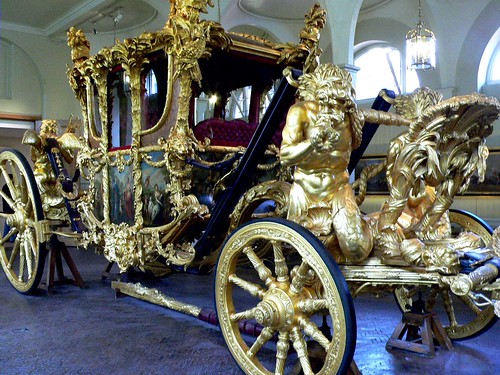
Buckingham Palace, The Royal Mews, Trafalgar Square, The Victoria Memorial, Madame Tussaud's, Westminster Abbey, The British Museum, Portobello Road Street Fair, Oxford University, Stratford-On-Avon, Warwick Castle, Stonehenge, Roman Bath, Windsor Castle, Leed's Castle, Ingtham Mote, Lullingstone Villa, Big Ben and Parliament, and all the little nooks and crannies around our hotel. Today, we're going to the
I have the train information to St. Alban's for Saturday where I'll see the
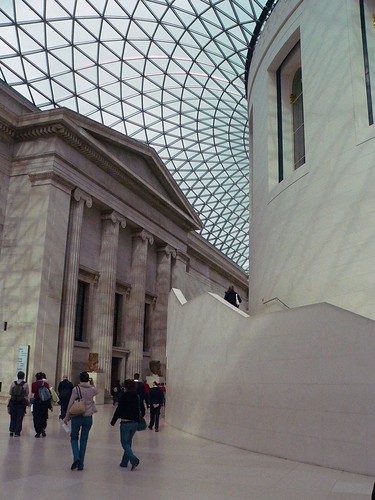
British Museum, The Royal Mews, Lullingstone Villa, Ingtham Mote, Leeds Castle, Oxford, Stratford-On-Avon then Warwick Castle - oh my!
Wednesday, April 5, 2006: - Sorry to interrupt my commentary for so long but the internet was, as my British friends would say, a bit dodgy on Sunday and we returned too late Monday and was too tired to write Tuesday after touring all day.
Sunday we spent all morning at the
Of course I made a point of seeing the
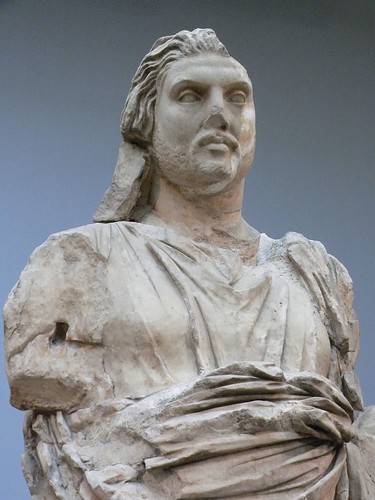
I managed to photograph what I thought was the most interesting of the Greek, Roman, and Near East exhibits and started on the Egyptian exhibits when I had to report back to the main hall to meet my sister for lunch. I love the Greco-Roman mummy portraits from the Fayum region of Egypt and was lucky enough to see the beautifully painted sarcophagus of Artemidorus. I had watched a BBC program where the mummy was CAT-scanned during a study of it and never thought I would actually get to see Artemidorous' handsome visage in person.
Walking back to the Victoria Memorial so I could finish photographing it, I took a nose dive on the uneven paving stones along the side of
Next, we toured a beautiful medieval manor house at Ingtham Mote. This moated structure was built in 1320. The original owner is now thought to be Isolde Inge later called St Pere. Until recently, Sir Thomas Cawne, a knight who
Historians attribute its amazing state of preservation to the fact that none of its residents were particularly ambitious, seemingly satisfied to fulfill their roles as squires, sheriffs, or courtiers. That's not to say the house didn't witness at least a little intrigue. One of the subsequent owners, William Haute, joined Jack Cade and other lords, magnates and people of Kent to issue the The Complaint of the Poor Commons of Kent against Henry VI. Haute's son (or grandson) Richard, later joined in a rebellion against Richard III. So it may seem like a miracle that Ingtham's closest brush with destruction is said to have occurred during the English Civil War when Cromwell's soldiers, who had planned to loot Ingtham Mote, lost their way and ended up sacking another estate instead. I'm sure each visitor to the house is truly grateful! More pictures...
"Wonderful in manifold glories are the great castle visions of Europe; Windsor from the Thames, Warwick or Ludlow from their riversides, Conway or Caernarvon from the sea, Amboise from the Loire, Aigues Mortes from the lagoons, Carcassonne, Councy, Falaise and Chateau Gaillard - beautiful as they are and crowned with praise, are not comparable in beauty as with Leeds, beheld among the waters on an autumnal evening when the bracken is golden and there is a faint blue mist among the trees - the loveliest castle, as thus beheld, in the whole world." - Lord Conway
Originally the Saxon manor named Esledes, Leeds Castle was a stronghold of the Saxon royal family beginning with the reign of Ethelbert IV (856-860). It was later conveyed to the powerful house of Godwin by Edward the Confessor but following the Norman conquest it was granted to a cousin of William II Rufus, Hamo de Crevecoeur. When the de Crevecoeur family fortunes waned following the battle of Evesham in 1265, the castle passed to Sir Roger de Leyburn. His son later conveyed the castle to Edward I and his queen, Eleanor of Castile. From that point for the next three hundred years, Leeds Castle remained a royal home.
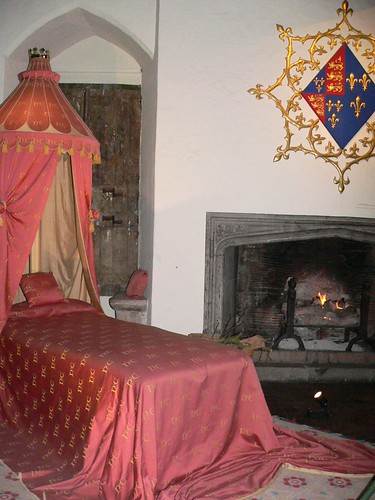
The queen's bath was canopied with white damask and was designed to be easily dismantled so it could be moved to another residence when the queen relocated to another palace or outdoors in good weather.
Hot baths were still very popular during the early Middle Ages and most towns, as late as the mid-1200s had public bathhouses.
"By the mid-1300s, only the very wealthy could afford firewood for hot water in the winter. The rest of the population was forced to be dirty most of the time." - medieval-life.net
Henry the VIII refurbished Leeds Castle early in his marriage to Catherine of Aragon and the room termed the Queen's Gallery reflects their relationship in its ragstone fireplace emblazoned with the coat of arms of the House of Lancaster and the castle of Castile as well as the pomegranates of Aragon. However, Henry spent little time there after their separation. But, the faint play of light on a shadowed bust of Henry in this room gave me the feeling his spirit still frequents these halls.
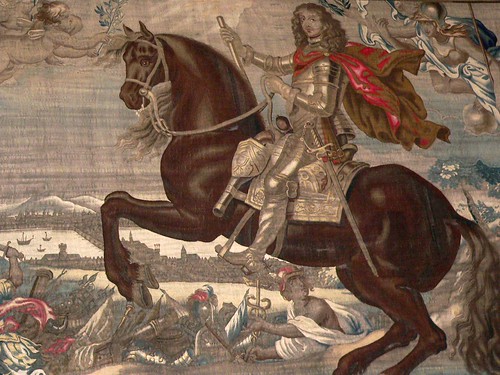
A number of portraits and busts of the Tudor dynasty adorn Leeds Castle but I was particularly struck by a portrait labeled as unidentified but attributed to Marcus Gheeraerts the Younger (1561-1635). Gheeraerts painted a number of portraits of Queen Elizabeth I but for some reason, art historians are hesitant to identify this portrait as one of them even though the lady wears a white dress (Elizabeth's favorite colors were white and black), she wears a crown upon auburn hair, and is lavishly adorned with pearls (another symbol used frequently by Elizabeth to emphasize her personnae as the "Virgin Queen".
Perhaps I was simply pleased to take my own photo of a potential Queen Elizabeth portrait in a white gown that I can use as I please after locking horns with the National Portrait Gallery over the noncommerical, educational use of an image of a similar portrait of Elizabeth in their collection. See Copyright Wars
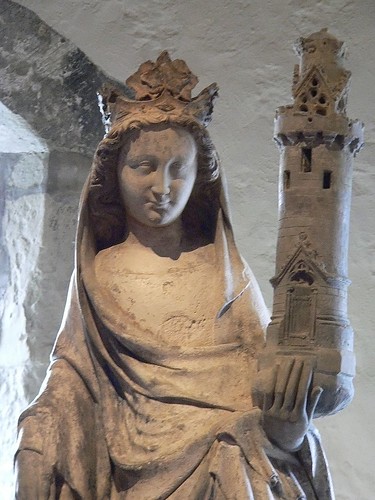
"According to legend, Saint Barbara was the extremely beautiful daughter of a wealthy heathen named Dioscorus, who lived near Nicomedia in Asia Minor. Because of her singular beauty and fearful that she be demanded in marriage and taken away from him, he jealously shut her up in a tower to protect her from the outside world.
Shortly before embarking on a journey, he commissioned a sumptuous bathhouse to be built for her, approving the design before he departed. Barbara had heard of the teachings of Christ, and while her father was gone spent much time in contemplation. From the windows of her tower she looked out upon the surrounding countryside and marveled at the growing things; the trees, the animals and the people. She decided that all these must be part of a master plan, and that the idols of wood and stone worshipped by her parents must be condemned as false. Gradually she came to accept the Christian faith.
As her belief became firm, she directed that the builders redesign the bathhouse her father had planned, adding another window so that the three windows might symbolize the Holy Trinity.
When her father returned, he was enraged at the changes and infuriated when Barbara acknowledged that she was a Christian. He dragged her before the perfect of the province, who decreed that she be tortured and put to death by beheading. Dioscorus himself carried out the death sentence. On his way home he was struck by lightening and his body consumed." - The Legend of St. Barbara
Another interesting sculpture is the carved oak figure of a laughing crusader at the head of the spiral staircase leading to the Gloriette Landing. The 16th-century style oak staircase was actually built by Armand Albert Rateau in 1929 but the figure gripping his sword and shield blend nicely with the genuine period art throughout the house. One concession is made to modern interpretation however. The crusader's shield bears a grinning lion sticking its tongue out as if the crusader was a refugee from Monty Python's dubious heroes in "The Holy Grail".
Lady Baillie's bedroom was redesigned to emulate the Regence style of the early 18th century. Boudin installed blue boiserie with several doors concealed behind the azure panels. To reflect Lady Baillie's love of birds, Boudin placed bird-shaped
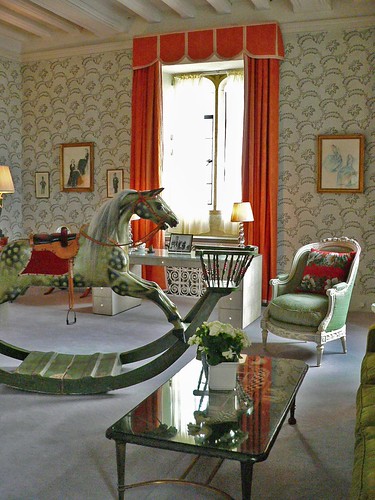
One of Boudin's last commissions in the 1960s was to convert the bedroom that had once been used by Queen Catherine of Aragon to a boudoir. Again he used white bedding and woodwork to emphasize the size of the room but incorporated a homey warmth with country-style wallpaper and a playful Victorian rocking horse.
"When he knew he was dying and in great secrecy, a priest, Father John Huddleston, was summoned to his bedside. Charles was admitted into the Catholic Church and received the last rites. He was succeeded by the Duke of York, who became James II in England and Ireland, and James VII in Scotland." - Wikipedia
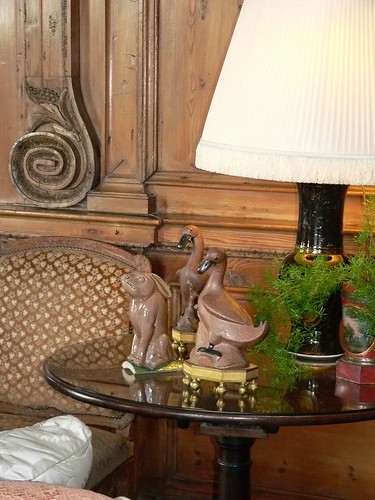
The Thorpe Hall Room features warm, ornately carved-pine panelling rescued from a coat of green paint and brought to Leeds from Thorpe Hall near Peterborough. It was originally designed in 1653 by Peter Mills, who, together with Sir Christopher Wren, famous architect of St. Paul's Cathedral, supervised the rebuilding of London after the Great Fire of 1666. Once again we find birds as accent pieces. This time they are 19th century Chinese biscuit-ware ducks. They are accompanied by a Chinese ridge tile rabbit.
Wood carvers of this period often used tints of red, blue, green or white to add detail to their work. Bands of carvers would often travel from church to church embellishing altars and choir screens. One such carver was probably comandeered for this commission. - See the history of woodcarving
One of the contestants in the Hundred Years War, Edward III was the founder of the chivalrous " Order of the Garter, allegedly as a result of an incident when a lady, with whom he was dancing at a court ball, dropped an item of intimate apparel (possibly a sanitary belt, though sources describe it as being made of velvet). Gallantly picking it up to assuage her embarrassment, Edward tied it around his own leg, and remarked Honi soit qui mal y pense ('Shame on him who thinks evil of it'), which became the motto of the Order of the Garter." - Wikipedia
He also fathered the famous "Black Prince", Edward of Woodstock. Like Alexander the Great, Edward demonstrated his courage and military talent at the age of 16 at the Battle of Crecy.
As the light began to fade toward sunset, Richard took us to